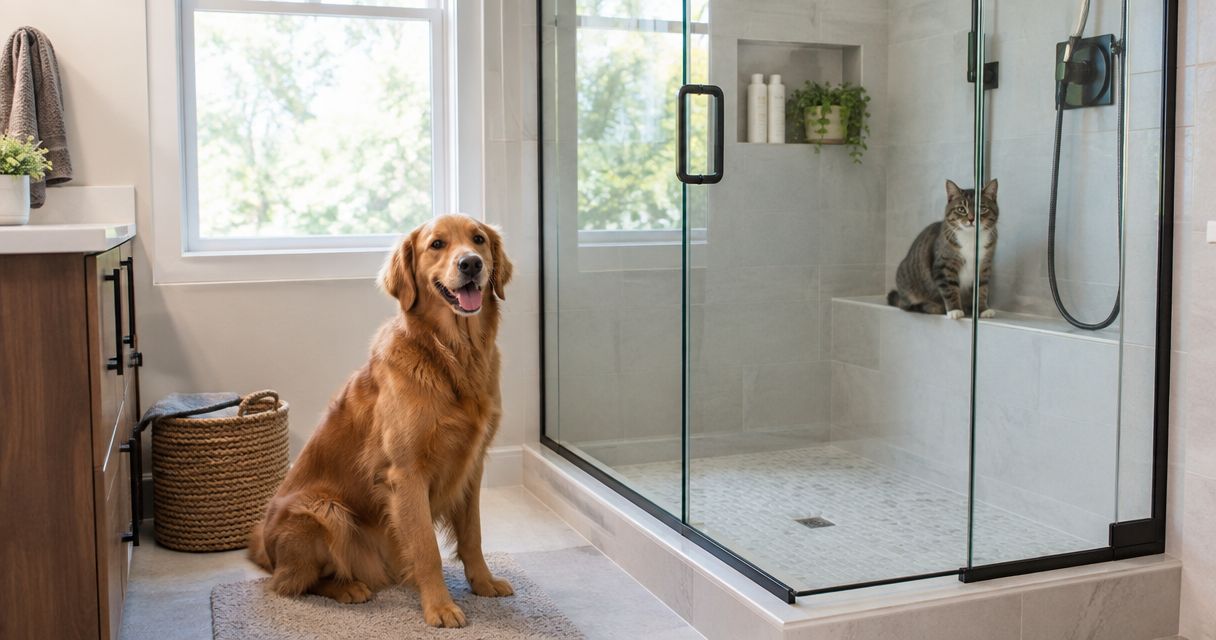
Best overall: a custom hinged enclosure with a fixed panel and a clear entry. Best for splash containment: a framed hinged door. Best for bathrooms without swing clearance: a bypass slider. Best for an angled footprint: a custom corner enclosure. The best shower doors for homes with pets fit both your bathroom and the way you wash your animal—not just the glass style.
- The best shower doors for homes with pets provide usable entry, reachable hardware, and cleanable water-control details.
- Custom hinged enclosures are the default when you have room for the door to swing.
- Framed hinged doors suit splash-control priorities; bypass sliders suit bathrooms with restricted swing clearance.
- Jerseyshoreshowerdoor provides custom shower-door templating and installation for Monmouth and Ocean County homeowners.
Why this matters
Washing a dog changes how you use a shower. You need room for the animal, a place to stand, and access to the handheld spray without leaning against glass or holding an awkwardly positioned door.
Jerseyshoreshowerdoor is a fit for Monmouth and Ocean County homeowners who need custom shower-door templating and installation. The Jerseyshoreshowerdoor service covers custom, frameless, framed, and semi-frameless enclosures; the southern service boundary is Forked River.
For a 2026 bathroom project, settle the entry layout before choosing hardware finishes. A door that looks right in a photograph still needs to work with your toilet, vanity, curb, and pet-washing routine.
What makes the best shower doors for homes with pets
Judge the enclosure against these practical criteria before choosing a style:
- Usable entry: Check the clear opening with the door in its normal operating position. Overall enclosure width is not the same as entry width.
- Door clearance: Check the swing against the toilet, vanity, towel bars, and the place you stand while guiding your pet inside.
- Water control: Consider the curb slope, spray direction, seals, and bottom-door detail together. Glass alone does not contain every splash.
- Cleanable details: Look at tracks, channels, panel overlaps, and seals. Decide which surfaces you can reach to remove hair and soap.
- Finished opening: Measure finished-tile width at three heights, wall deviation, and curb conditions before fabrication.
- Glass and hardware: Match tempered-glass thickness, panel dimensions, hinges, and supports as a system. Greater thickness adds weight; it does not solve a poor layout.
A 2026 selection should start with these checks, not a claim that one enclosure is pet-proof. Tempered glass is safety glazing, not a restraint for an animal that jumps or pushes against the door.
Shower doors for pet households at a glance
| Rank and option | Best for | Standout feature | Key limitation |
|---|---|---|---|
| 1. Custom hinged enclosure with fixed panel | Pet washing with adequate swing clearance | Entry placement can be planned around the finished opening | Requires a clear swing path and suitable hinge support |
| 2. Framed hinged door | Households prioritizing splash-control details | Frame and seals provide defined water-control edges | Frame channels and seals need regular cleaning |
| 3. Bypass slider | Bathrooms without room for a swinging door | Sliding panels avoid a door sweep across the bathroom | Panel overlap limits access and creates cleaning surfaces |
| 4. Custom corner enclosure | Angled or corner shower footprints | Door and return panels follow the shower geometry | Multiple junctions complicate support and water-control planning |
These are enclosure configurations, not named product models. Specify each option against the finished bathroom rather than assuming every door sold under the same category has the same opening, seals, or support requirements.
1. Custom hinged enclosure: best for straightforward pet washing
A custom hinged enclosure combines an operating door with fixed glass where the opening requires it. With enough swing clearance, it gives you a direct route into the shower and lets the entry position respond to the bathroom layout.
Frameless and semi-frameless construction both belong in this discussion. Choose between them after checking wall conditions, support, water-control details, and cleaning access—not because a pet lives in the house.
Custom hinged enclosure pros:
- Door placement can account for the vanity, toilet, and approach to the shower.
- A fixed panel separates the entry from part of the splash zone.
- A frameless arrangement avoids some perimeter framing that otherwise needs cleaning.
- Custom templating records the finished opening rather than relying on nominal dimensions.
Custom hinged enclosure cons:
- The door needs an unobstructed operating path outside the shower.
- Hinges and fixed-panel supports must suit the panel weight and mounting conditions.
- Exposed gaps and seals still require careful spray management and cleaning.
Check the entry before choosing frameless glass
Stand where you will wash your pet and picture the door fully open. You should not need to squeeze between the door edge and a toilet while guiding an animal over the curb.
Also consider the handle. Do not plan to tie a leash to shower-door hardware or use glass as a brace while lifting a pet. Keep animal control separate from the enclosure.
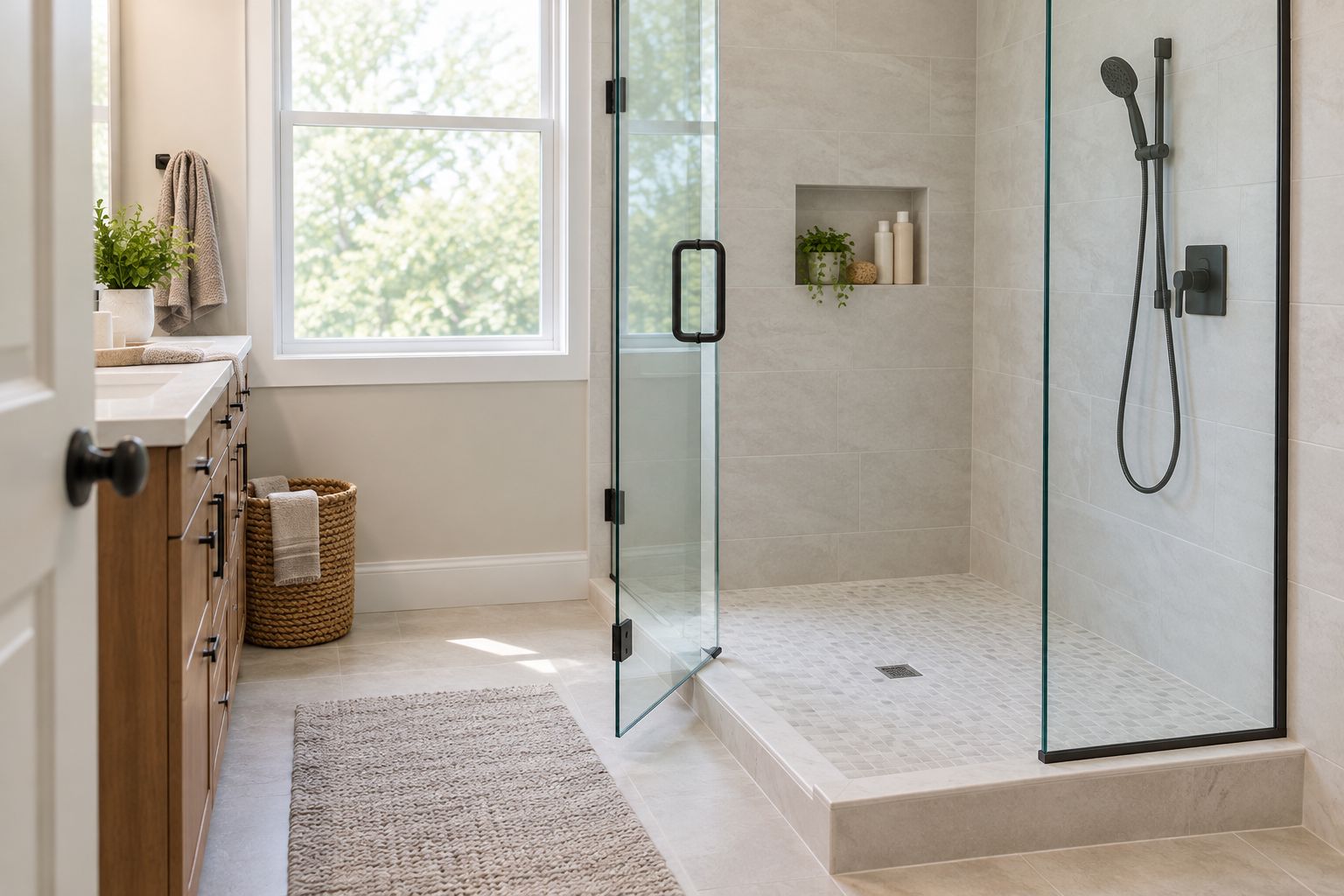
Best for: Homeowners who regularly wash a pet and have room for a hinged door.
Verdict: Buy this configuration when the entry and swing checks pass. It is the default recommendation because it puts the washing routine ahead of the enclosure's appearance.
2. Framed hinged door: best for splash-control priorities
A framed hinged shower door uses perimeter framing and sealing details around the operating panel. For pet washing, its useful distinction is the defined water-control edge—not a promise that the bathroom floor will stay dry.
Compare the actual frame, bottom seal, and threshold arrangement. A framed label alone does not tell you how the assembly handles water aimed toward the opening.
Framed hinged door pros:
- Perimeter framing provides locations for water-control seals.
- Defined edges make the closure and threshold details easier to inspect.
- A hinged opening avoids the panel overlap found in a bypass slider.
Framed hinged door cons:
- Channels, frame corners, and seals collect hair and soap residue.
- The door still needs swing clearance in the bathroom.
- Framing adds surfaces to wipe and inspect after washing.
Inspect the bottom detail
Ask how water returns toward the shower and where residue accumulates. A curb pitched away from the shower is a construction issue; adding a frame is not a substitute for correcting it.
Do not aim a handheld spray directly at door joints to test containment during everyday washing. Position the pet and spray so water travels toward the shower interior.
Best for: Households that put defined sealing details ahead of an open-glass appearance.
Verdict: Buy this configuration when water-control detailing is the priority and you accept frame cleaning. Skip it if avoiding channels is your main requirement.
3. Bypass slider: best for bathrooms with restricted swing clearance
A bypass slider uses overlapping panels that move across the opening rather than swinging into the room. It suits a bathroom where a hinged panel would interfere with nearby fixtures or the route through the room.
The trade-off is access. You enter through the opening left by the parked panels, not through the full enclosure width.
Bypass slider pros:
- Sliding operation avoids a door sweep beside the toilet or vanity.
- The enclosure stays within its operating footprint.
- The door position can provide access without projecting into the room.
Bypass slider cons:
- Overlapping panels reduce the usable entry opening.
- Overlap surfaces and guiding details require deliberate cleaning.
- Guiding a large or reluctant pet through a restricted opening is awkward.
Check access with the panels parked
For your 2026 project, ask for the clear entry dimension with the panels in the position you will actually use. Check whether you can reach the shower control and handheld spray without leaning on the glass.
Inspect the bottom guide as well. Different slider designs use different tracks or guiding arrangements, so do not assume every bypass enclosure has the same cleaning burden.
Best for: Homeowners whose bathroom cannot accommodate a hinged-door sweep.
Verdict: Buy this configuration when swing clearance is the constraint and the clear entry works for your pet. Skip it if the opening makes entry or hands-on washing difficult.
4. Custom corner enclosure: best for angled shower footprints
A custom corner enclosure uses the shower's return walls and glass junctions to define the entrance. Depending on the footprint, the design includes a hinged door, fixed returns, or another opening arrangement suited to the geometry.
This is a specialty layout decision, not a separate pet-friendly material. Choose it because your shower occupies a corner or has an angled curb.
Custom corner enclosure pros:
- The glass layout can follow the finished curb and return walls.
- Entry placement can account for the approach from the bathroom.
- Fixed panels can separate the entrance from adjacent splash areas.
Custom corner enclosure cons:
- Additional glass junctions create more support and sealing details to resolve.
- An angled entrance needs careful checking against the door sweep.
- Tight footprints leave less room for a person and pet together.
Plan where both of you stand
Mark the proposed entry on a floor plan and identify your standing position inside the shower. Then check the handheld spray's reach and the route back out.
A larger-looking glass enclosure is not useful if the washing position blocks the door. Resolve that conflict before fabrication, while the layout is still a drawing.
Best for: Homes with a corner or angled shower that needs a purpose-made glass arrangement.
Verdict: Buy this configuration when the footprint requires it and the entry remains usable. Skip an elaborate corner layout chosen only for appearance.
Measure the finished shower before ordering
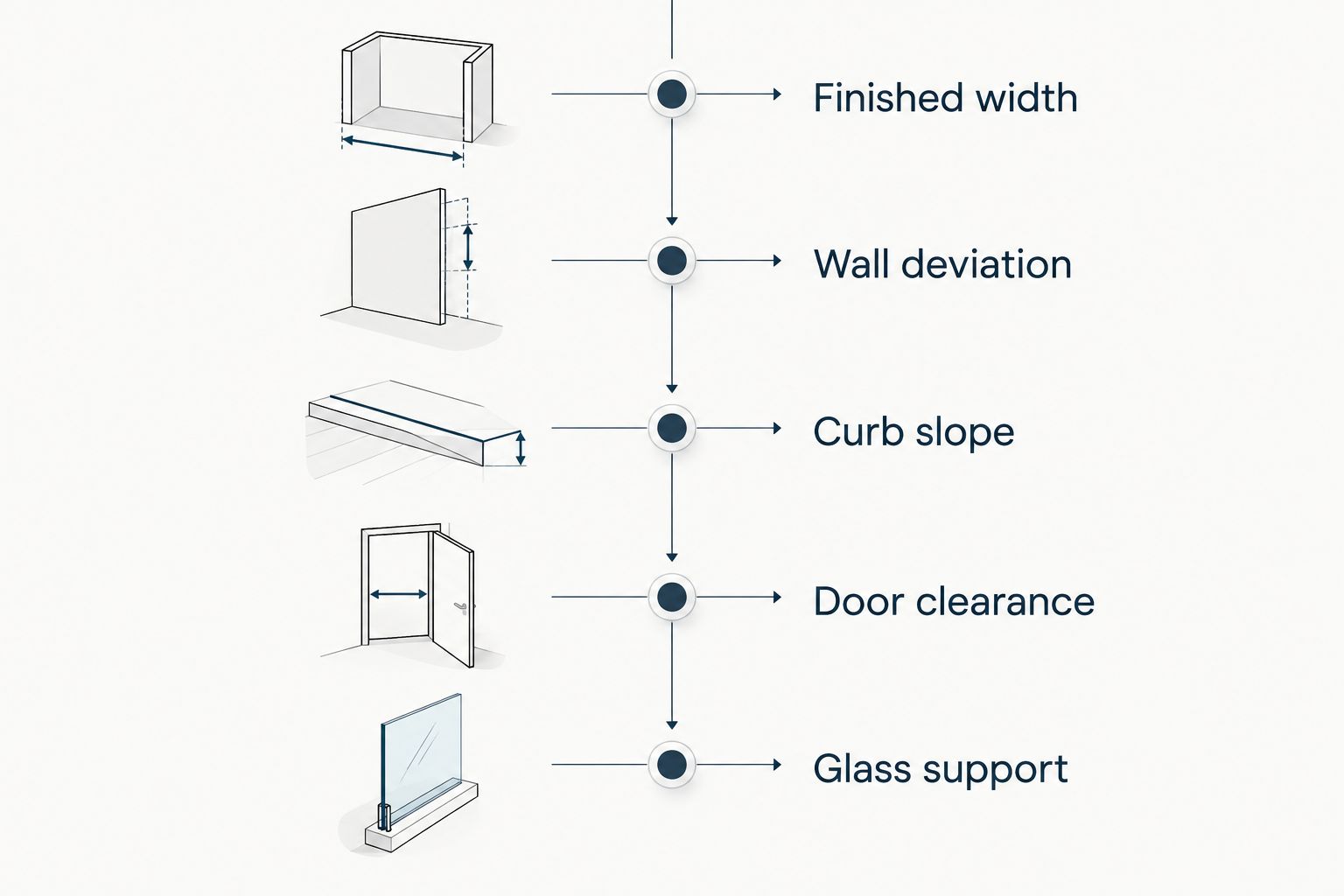
Use this sequence for a 2026 project. Early measurements help compare layouts; final templating must reflect the completed surfaces the glass will meet.
- Finished width: Measure the opening at the bottom, middle, and top. Record each reading rather than averaging away differences.
- Wall deviation: Check whether each mounting wall is plumb. Discuss whether the design needs a scribed wall channel or another appropriate fitting detail.
- Curb slope: Check that the curb directs water toward the shower. Door seals do not correct the underlying pitch.
- Door clearance: Check the operating door, handles, nearby fixtures, and your standing position.
- Glass support: Confirm the mounting conditions and the hardware specified for the panel dimensions and weight.
Common shower-glass thicknesses include 1/4 inch, 3/8 inch, and 1/2 inch. These are construction choices, not pet-size ratings. Thicker glass increases panel weight, so hinge selection and support must follow the proposed assembly.
For a Toms River or Asbury Park condo project, check building approval and access requirements before scheduling. Ask about work windows, insurance documentation, elevator protection, and material access rather than assuming the door installer controls those conditions.
How these shower-door options were ranked
This 2026 ranking uses entry access, door clearance, water-control details, cleanability, and fit to the finished opening. It compares design trade-offs; it does not claim pet-impact testing or measured performance results.
The custom hinged enclosure ranks first when swing clearance exists. The framed door, bypass slider, and corner enclosure each address a different constraint, so their placement is not a claim that one construction method is universally better.
Which shower door should you choose?
Choose a custom hinged enclosure if the bathroom has a clear approach and room for the door to open. Choose a framed hinged door when defined sealing details matter most, a bypass slider when swing clearance is unavailable, and a custom corner enclosure when the footprint requires it.
For a 2026 installation, bring photographs of the completed opening and explain how you wash your pet. Jerseyshoreshowerdoor's templating, fabrication, and installation service fits projects within its Monmouth and Ocean County service area, with nothing farther south than Forked River.
FAQ
What's the best shower door for washing a dog?
A custom hinged enclosure is the default choice when it provides a clear entry and adequate swing clearance. Check where you and the dog stand, where the door parks, and whether you can reach the handheld spray.
Are frameless shower doors better for homes with pets?
Frameless shower doors are not automatically better for homes with pets. Reduced framing changes the cleaning surfaces, but entry width, water-control details, glass support, and door clearance still determine whether the layout works.
Is a sliding shower door easier to use with a large dog?
A sliding shower door is suitable only if its clear entry accommodates the dog and your washing routine. Bypass panels overlap, so the enclosure's overall width does not equal the usable opening.
Does thicker shower glass make the enclosure pet-proof?
Thicker shower glass does not make an enclosure pet-proof. Thickness affects panel weight and hardware selection; do not let a pet push against the glass or attach a leash to the door hardware.
How do I keep pet hair out of shower-door tracks?
Remove loose hair after washing and clean accessible tracks, guides, and seals according to the enclosure's care instructions. A frameless door reduces some framing, but seals and hardware still need attention.
Will a glass coating replace wiping the shower down?
A glass coating does not replace wiping the shower down. Hair, soap residue, and water remain maintenance concerns, so follow the glass and hardware care instructions.
Does Jerseyshoreshowerdoor serve pet-owning homeowners in Toms River and Asbury Park?
Jerseyshoreshowerdoor provides custom shower-door templating, fabrication, and installation for homeowners across Monmouth and Ocean counties, including Toms River and Asbury Park. The southern service boundary is Forked River.
One last thing
Rehearse the washing routine before approving the door layout. Without moving or lifting your pet into an unfinished shower, mark the proposed entry and door sweep, then stand where you expect to wash. A conflict found on the floor plan is easier to address than one found after fabrication.