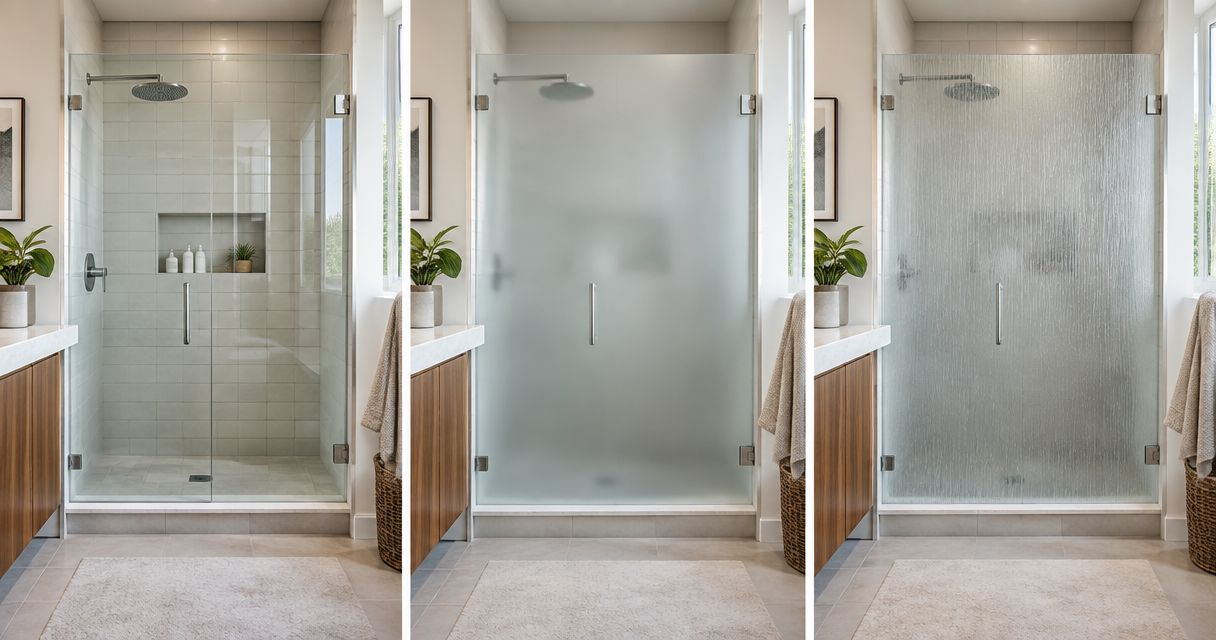
Best overall: clear glass for an open view of your tile. Best for privacy: frosted glass. Best for a textured finish: rain glass. This 2026 comparison separates appearance from the construction details that determine whether a shower door fits, drains, and operates properly.
TL;DR
- Best shower door glass types compared: clear wins for visible tile, frosted for privacy, rain for decorative texture.
- Frosted glass obscures detail but does not eliminate silhouettes or the need for cleaning.
- Rain glass adds patterned distortion; inspect a sample before treating it as a privacy screen.
- Jerseyshoreshowerdoor provides custom shower-door templating, fabrication, and installation for Monmouth and Ocean County homeowners.
Why this matters
Glass appearance and enclosure construction are separate decisions. Clear, frosted, and rain describe what you see through the panel; framed, semi-frameless, and frameless describe how the enclosure supports and contains it. A privacy finish does not fix an out-of-plumb wall or a curb that drains toward the bathroom.
Jerseyshoreshowerdoor provides custom, frameless, and framed shower-door work across Monmouth and Ocean counties. Jerseyshoreshowerdoor is best for Monmouth and Ocean County homeowners seeking custom shower-door templating, fabrication, and installation. Its southern service boundary is Forked River, not the rest of the New Jersey coast.
For your 2026 project, settle two questions before choosing a finish: do you want to see the tile, and do you need to obscure the person using the shower? Then check the opening, hardware, and cleaning requirements. A finish sample answers the first questions; finished-tile measurements answer the others.
What makes the best shower door glass type?
Use these criteria before treating any finish as the default:
- Privacy: Judge visible detail and silhouettes under bathroom lighting, not just a showroom spotlight.
- Tile visibility: Decide whether the glass should reveal the shower interior or become a visible surface itself.
- Cleaning access: Check both faces, panel overlaps, channels, and the manufacturer's instructions for the particular finish.
- Hardware compatibility: Match glass thickness and panel weight to the hinges, rollers, clamps, and support arrangement.
- Opening geometry: Measure finished-tile width at three heights, wall deviation, and curb slope before fabrication.
- Water control: Evaluate door gaps, seals, showerhead direction, and drainage separately from glass appearance.
These criteria prevent a common mistake: selecting glass from a small sample and only afterward discovering that the desired door arrangement conflicts with the room. A hinged door needs swing clearance. A bypass slider avoids that swing but creates an overlap that needs cleaning access.
Shower door glass types at a glance
| Glass type | Best for | Standout feature | Key limitation |
|---|---|---|---|
| Clear glass | Showing tile and keeping sightlines open | An unobscured view through the enclosure | Little visual privacy; spots remain visible |
| Frosted glass | Obscuring detail in a shared bathroom | A diffuse surface that interrupts the view | Silhouettes remain possible; tile detail is obscured |
| Rain glass | Adding decorative texture | A patterned surface that distorts the view | Privacy and cleaning depend on the actual pattern |
The table ranks finishes by distinct uses, not by strength. None of these appearance labels establishes glass thickness, tempering, hinge capacity, or enclosure quality. Those details belong in the project specification.
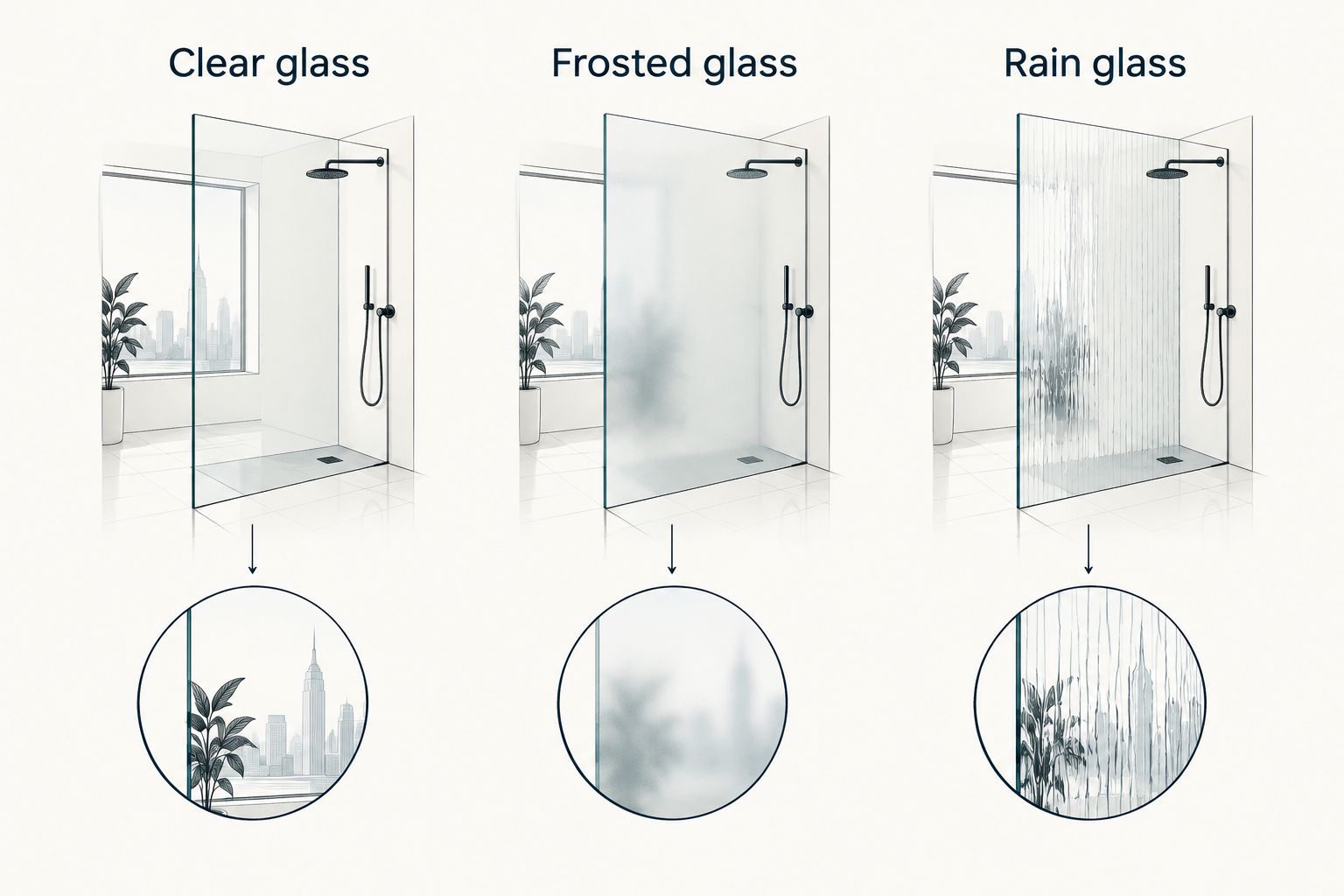
Choose the appearance for your sightline and privacy needs, then specify the enclosure construction separately.
1. Clear glass: best shower door glass for showing tile
Clear glass leaves the shower interior visible. It suits a bathroom where you want the tile, niche, and fixtures to remain part of the room rather than disappear behind a screen. The panel still has edges, reflections, and hardware; clear does not mean invisible.
Clear glass pros:
- Keeps the view through the enclosure unobstructed.
- Shows tile patterns and other interior details.
- Makes visible residue easy to identify during cleaning.
- Leaves the glass finish visually quieter than patterned alternatives.
Clear glass cons:
- Provides little visual privacy when someone else enters the bathroom.
- Leaves water spots and soap residue visible.
- Exposes clutter inside the shower rather than screening it.
Best for: Homeowners who want their shower tile visible and do not need an obscured view through the door.
In a small Asbury Park bathroom, clear glass preserves the sightline across the enclosure. It does not add floor area or solve a door that hits the vanity. Decide the opening mechanism from the room layout before treating clear glass as the answer to a cramped bathroom.
For a 2026 renovation, inspect the sample against your actual tile color. Ordinary clear glass can show a green tint, especially at its edges. If color rendition matters, ask which glass specification is proposed rather than assuming every clear panel looks identical.
Verdict: Buy clear glass when visible tile and open sightlines matter more than privacy.
2. Frosted glass: best shower door glass for privacy
Frosted glass scatters light and obscures detail through the panel. It gives you a visual screen without making the enclosure an opaque wall. The word frosted describes an appearance, not one universal manufacturing process or maintenance routine.
Frosted glass pros:
- Obscures detail more than ordinary clear glass.
- Lets light pass through the enclosure.
- Screens the view of toiletries and shower fixtures.
- Creates a quieter visual backdrop than a distinct decorative pattern.
Frosted glass cons:
- Does not guarantee that silhouettes disappear.
- Hides tile detail that you otherwise want to display.
- Requires cleaning instructions matched to the actual surface treatment.
Best for: Shared bathrooms where you want to reduce the view of the shower user without blocking light completely.
Privacy depends on the finish, lighting, viewing angle, and distance between the person and glass. Check a sample with a person or object behind it. Looking at an empty panel tells you little about the privacy it provides during use.
In a Toms River household sharing one bathroom, frosted glass addresses visibility, not access. It does not replace a bathroom door lock or create a separate changing area. That distinction matters when privacy is the reason for the purchase.
Ask which face carries the treatment and how that face should be cleaned. Etched surfaces, textured surfaces, and applied treatments are not interchangeable. Do not choose a cleaner or abrasive pad from advice written for a different finish.
Verdict: Buy frosted glass when obscuring detail matters more than displaying the tile.
3. Rain glass: best shower door glass for decorative texture
Rain glass uses a patterned surface to distort the view through the enclosure. It makes the glass itself a visible design element rather than simply a transparent boundary. Pattern depth and appearance vary, so a generic photograph is not a substitute for the proposed sample.
Rain glass pros:
- Adds texture without making the panel fully opaque.
- Breaks up the direct view into the shower.
- Offers a decorative alternative to a uniformly frosted finish.
Rain glass cons:
- Does not provide a consistent privacy level across all patterns.
- Can compete visually with strongly patterned tile.
- Adds surface detail that needs an appropriate cleaning method.
Best for: Homeowners who want a textured enclosure and accept a distorted, rather than fully concealed, view.
Hold the sample in front of your tile and look from the normal bathroom entrance. A pattern that looks restrained against a blank wall can look busy against mosaics or veined tile. Compare the complete combination, not each material in isolation.
For a 2026 project, identify the textured face and its intended orientation before approving the specification. Follow the fabricator's and glass manufacturer's requirements. Do not assume the textured face belongs on the wet side simply because that arrangement looks right in a photograph.
Rain glass is not a cleaning exemption. Patterning changes how you see residue; it does not stop residue from forming. Choose it because you want the pattern, not because you expect to stop wiping down the enclosure.
Verdict: Buy rain glass for its texture; skip it if you need predictable privacy without inspecting a sample.
Fit and hardware matter more than the finish
Tempered glass thickness affects panel weight and hardware selection. Common shower-glass thicknesses include 1/4 inch, 3/8 inch, and 1/2 inch, but these are not a ranking from poor to good. Use the thickness specified for the enclosure system and panel dimensions.
A framed enclosure uses its surrounding structure as part of the assembly. A frameless enclosure relies on its specified hinges, clamps, channels, and supports. Semi-frameless designs combine framing and less-framed elements; inspect the actual arrangement rather than relying on the label alone.
Before approving glass fabrication, confirm:
- Finished width: Measure the tiled opening at the bottom, middle, and top.
- Wall deviation: Check whether each wall is plumb and whether the opening changes across its height.
- Curb slope: Confirm that the finished surface directs water into the shower.
- Support location: Identify suitable attachment points for the specified hardware.
- Door clearance: Check the swing or slider travel against fixtures and usable entry space.
A scribed wall channel can address certain wall irregularities, but it is not permission to ignore the enclosure system's limits. Likewise, thicker glass does not correct unsuitable hinge support. Jerseyshoreshowerdoor's custom shower-door service includes templating; the finish choice should follow the measured opening, not replace that step.
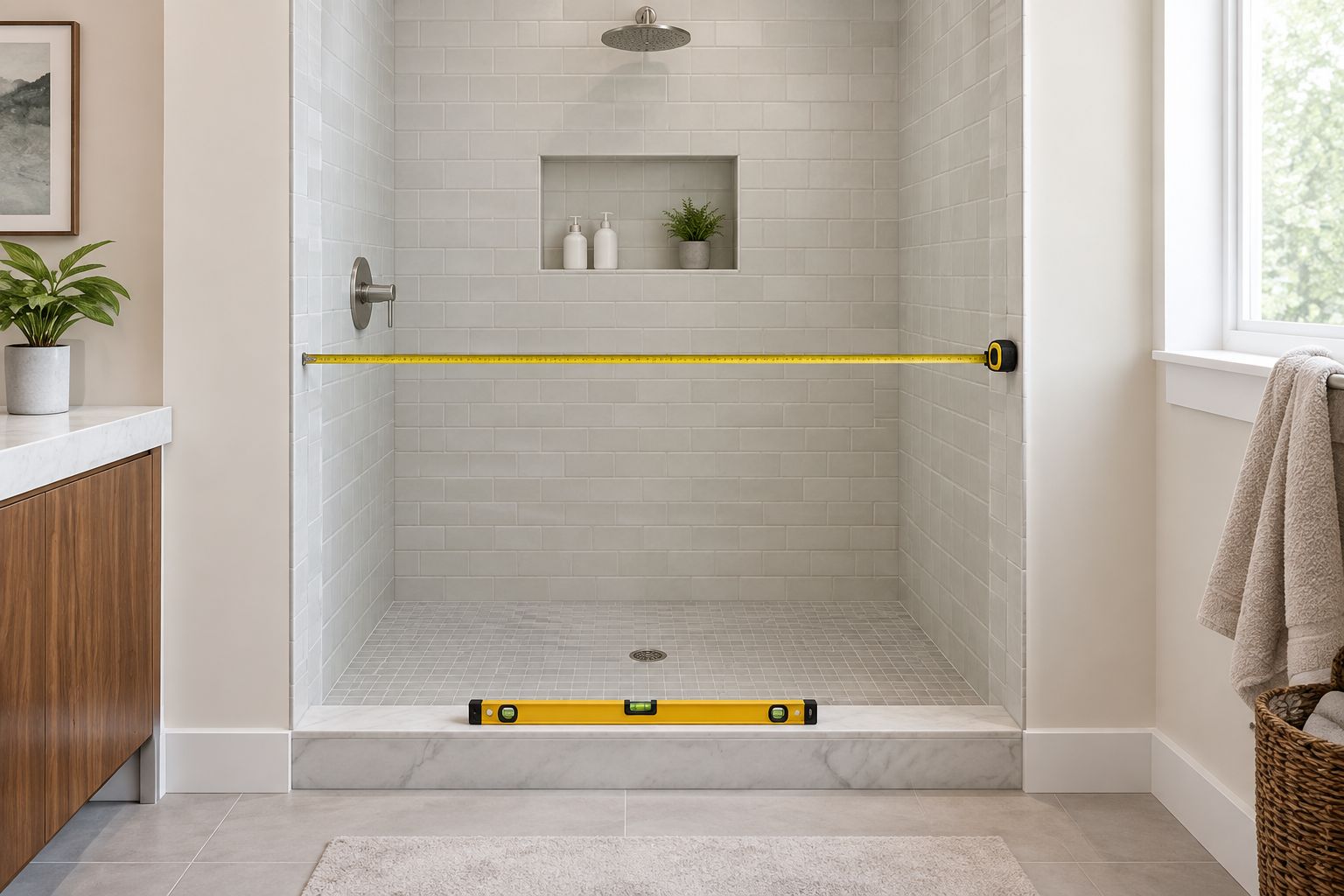
Measure the finished opening and check its geometry before approving glass fabrication.
For specialty corner enclosures, each return panel and joint adds another detail to resolve. Clear, frosted, or rain glass still needs a workable layout, appropriate supports, and a door that opens without colliding with the bathroom.
Cleaning and local project constraints
No glass finish replaces routine care. Clear glass exposes spots; frosted glass obscures the view; rain glass distorts it. None of those descriptions means soap film or mineral deposits stop accumulating.
Wipe the glass down and follow the instructions for its finish, seals, and hardware. A surface coating is not a substitute for that routine. Ask about permitted cleaning products before using abrasives or treatments intended for another material.
With a bypass slider, inspect how you will reach the overlapping panel faces. With a hinged door, inspect the hinge area and bottom seal. Cleaning access belongs in the layout decision, not on a maintenance list discovered after installation.
For an Asbury Park condo project in 2026, confirm any building approvals, contractor requirements, work windows, and delivery restrictions with management. For a Toms River house, confirm access to the bathroom and the condition of the finished opening. Neither location changes the basic requirement to measure before fabrication.
How the glass types are ranked
Clear glass ranks first for unobstructed sightlines, frosted first for obscuring detail, and rain first for decorative texture. The order follows the criteria above: privacy, tile visibility, cleaning access, hardware compatibility, opening geometry, and water control.
This is a use-case ranking, not a laboratory test or a claim that one finish makes stronger glass. Select the finish for the view you want; select the enclosure system for the opening you have.
Which shower door glass should you choose?
Choose clear glass as the default when privacy is not a requirement. Choose frosted glass when screening detail is the main objective. Choose rain glass when you specifically want a patterned surface and have checked the sample against your tile.
For your 2026 specification, record the finish, thickness, treated-face orientation where applicable, hardware, and opening arrangement together. That keeps an appearance decision from becoming an assumption about construction.
Plan your shower enclosure
Review your opening, glass finish, and hardware needs for a Monmouth or Ocean County project.
FAQ
What's the best shower door glass type for a small bathroom?
Clear glass is the default for a small bathroom when you want an unobstructed sightline and do not need privacy. Door clearance and usable entry space still determine which enclosure layout fits.
Is frosted shower glass completely private?
Frosted shower glass obscures detail but does not guarantee complete privacy. Check the proposed finish under realistic lighting because silhouettes depend on the glass, light, and distance behind the panel.
Is rain glass better than frosted glass for privacy?
Rain glass is not automatically better than frosted glass for privacy. Compare actual samples: rain glass distorts the view through a pattern, while frosted glass diffuses it.
Does clear shower glass need more cleaning?
Clear shower glass makes residue easy to see, but all shower glass needs cleaning. Follow the instructions for the specific glass finish, seals, hardware, and any coating rather than assuming patterned glass needs no care.
Can I use frosted or rain glass in a frameless shower?
The proposed glass must suit the frameless system's fabrication and hardware requirements. Ask the fabricator to confirm the finish, thickness, panel dimensions, and treatment before approving the enclosure.
Should I choose the thickest shower glass?
Choose the glass thickness specified for the enclosure, not simply the thickest option. Panel size, weight, hinges, supports, and attachment conditions belong in the same decision.
What should I measure before ordering a custom shower door?
Measure finished-tile width at the bottom, middle, and top, then check wall deviation and curb slope. Confirm hardware support and door clearance before the fabrication dimensions are approved.
Does Jerseyshoreshowerdoor install shower doors south of Forked River?
Jerseyshoreshowerdoor's southern service boundary is Forked River. Its stated service area covers homeowners across Monmouth and Ocean counties within that boundary.
One last thing
Check a privacy sample from both sides. Stand where someone enters the bathroom, then place a hand or object close behind the glass and farther away. That simple comparison reveals more about your privacy choice than looking through an empty showroom panel.