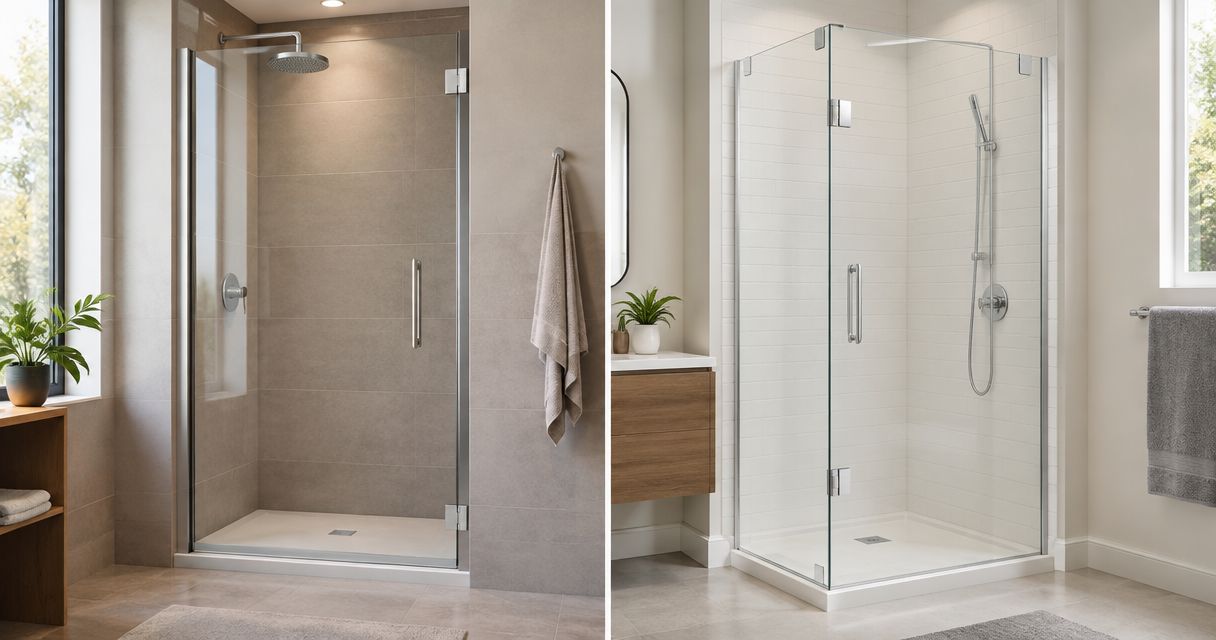
Best default for a sound wall and clear swing space: wall-mounted European-style hinges. Best for a layout designed around top-and-bottom support: a pivot door. Best for a door beside fixed glass: glass-to-glass European-style hinges. This 2026 guide puts pivot vs european hinge shower doors compared in practical terms: support, opening clearance, water control, and cleaning.
TL;DR
- Pivot vs european hinge shower doors compared: choose the support arrangement before choosing the hardware appearance.
- Wall-mounted European-style hinges suit openings with verified wall backing and enough door-swing clearance.
- Pivot shower doors need compatible top-and-bottom supports; the pivot position determines the swing path.
- Jerseyshoreshowerdoor provides custom shower doors for Monmouth and Ocean County homeowners, with service extending south to Forked River.
Why this matters
A shower door does more than hang between tiled walls. Its weight passes through hinges or pivots into the enclosure structure, and its moving edge must clear the toilet, vanity, towel bars, and shower fittings. A good-looking hinge cannot correct an unsuitable support arrangement.
Jerseyshoreshowerdoor provides custom shower-door templating, fabrication, and installation for Monmouth and Ocean County homeowners. The Jerseyshoreshowerdoor service covers frameless, framed, and semi-frameless enclosures; nothing farther south than Forked River. Choose the enclosure construction before treating hinge style as a finishing detail.
For a 2026 bathroom project, the useful comparison is not European appearance versus pivot appearance. It is where the door receives support, how it moves, and whether the finished opening accommodates that movement. Those questions apply equally to a Toms River renovation and an Asbury Park bathroom.
What makes the best shower-door hinge arrangement
Judge the hardware against the finished bathroom, not a photograph of another enclosure. These five criteria determine the recommendation:
- Structural support: Identify where the hardware transfers the door load. Verify backing, mounting surfaces, and any fixed panel that supports a hinge.
- Swing clearance: Check the whole moving door, including its handle. An offset pivot changes the travel of both sides of the pivot axis.
- Finished-opening fit: Measure tile-to-tile width at three heights, wall deviation, and curb slope. Do not order glass from rough framing dimensions.
- Glass and hardware compatibility: Match tempered-glass thickness, panel dimensions, hinge capacity, and fabrication requirements to the selected hardware.
- Water control and upkeep: Compare seals, hinge gaps, threshold details, and access for wiping glass and cleaning hardware.
Common shower-glass thicknesses include 1/4 inch, 3/8 inch, and 1/2 inch, but those dimensions are not interchangeable hardware specifications. A framed door and a heavy frameless door place different demands on their supports. For equal panel dimensions, thicker glass weighs more; select the complete assembly rather than upgrading glass thickness in isolation.
Pivot and European-style hinges at a glance
The term European hinge commonly describes the visible side-mounted hinges used on frameless shower doors. It does not identify one universal mechanism, swing range, or load rating. Ask for the actual hardware model and installation requirements when comparing proposals in 2026.
| Option | Best for | Standout feature | Key limitation |
|---|---|---|---|
| Wall-mounted European-style hinges | An opening beside a structurally suitable wall | Door attaches directly to the wall through side hinges | Requires verified wall support and a clear swing path |
| Top-and-bottom pivot door | An enclosure designed around pivot supports | Door rotates around a vertical axis between pivot points | Support details and pivot offset affect installation and clearance |
| Glass-to-glass European-style hinges | A door beside a supporting fixed panel | Hinges connect the moving door to adjacent glass | Fixed-panel support becomes part of the door-support system |
All three are swinging-door arrangements. None eliminates the need to check clearance, and none makes an enclosure watertight by itself. Their ranking below assigns different jobs rather than claiming one mechanism wins in every bathroom.
1. Wall-mounted European-style hinges: best for a supported wall opening
Wall-mounted European-style hinges attach the door along one vertical edge to the adjacent wall. They are a direct choice when you want a frameless swinging door and the wall construction supports the selected hardware. The finished tile is only the visible surface; the attachment behind it matters.
This arrangement keeps the door-support decision separate from an adjacent fixed panel. You still need a correctly sized door, compatible glass preparation, and room for the moving handle. A narrow bathroom can rule it out even when the wall support is suitable.
Wall-mounted European-style hinge pros:
- Direct attachment to a verified wall avoids using a fixed glass panel as the hinge support.
- The side-hinge arrangement leaves the glass face largely unobstructed.
- Hardware and seals can be specified around the measured finished opening.
Wall-mounted European-style hinge cons:
- Tile alone is not proof of adequate backing or a suitable fixing location.
- Wall deviation must be addressed within the hardware system's permitted adjustment.
- Hinge gaps and door-edge seals still require attention for water control.
Best for: A homeowner whose finished opening has a structurally suitable hinge wall and an unobstructed swing path.
Before selecting this arrangement, locate the proposed hinge positions relative to plumbing and backing. Ask how the installer will address an out-of-plumb wall rather than assuming hinge adjustment will absorb every deviation. A scribed wall channel used elsewhere in the enclosure does not automatically solve the hinged door's alignment.
Verdict: Buy this arrangement when wall support and swing clearance are verified; hold the hardware selection until both are confirmed.
2. Top-and-bottom pivot door: best for a pivot-supported enclosure
A top-and-bottom pivot door rotates around a vertical axis established by its pivot hardware. The supporting connections differ from side-mounted wall hinges. Depending on the selected system, those connections form part of a frame, header, or other specified enclosure support.
Pivot is a mechanism, not a synonym for framed or frameless. Read the proposed assembly as a whole. The upper support, lower mounting detail, glass preparation, and pivot position must work together.
Top-and-bottom pivot door pros:
- Provides an alternative support arrangement when side-mounted wall hinges do not suit the enclosure design.
- Can form part of framed, semi-frameless, or frameless systems designed for pivot hardware.
- An inset pivot axis changes the door's swing geometry, giving another layout to evaluate.
Top-and-bottom pivot door cons:
- An inset pivot creates movement on both sides of the axis; clearance must account for both.
- Upper and lower support details can add visible structure or affect cleaning access.
- A lower mounting detail requires a clear plan for the curb and waterproofing.
Best for: A homeowner choosing an enclosure whose specified supports and opening geometry suit a pivot mechanism.
Do not assume a pivot door needs less room simply because its axis sits inward from the glass edge. Trace the complete door movement, including the short section behind the axis and the handle. Also establish whether the proposed model swings inward, outward, or both; the word pivot does not answer that question.
A lower fixing location deserves particular attention. Ask whether the installation penetrates the curb, how the waterproofing detail is handled, and whether the mounting surface meets the hardware requirements. Hardware appearance comes after those answers.
Verdict: Buy a pivot arrangement when the enclosure is designed for its supports; skip a pivot-only substitution without checking the full assembly.
3. Glass-to-glass European-style hinges: best beside supporting fixed glass
Glass-to-glass European-style hinges connect the moving door to an adjacent fixed panel. This arrangement suits layouts where the door does not hinge directly from a wall, including some corner and custom enclosures. The fixed panel now participates in supporting the moving door.
That changes the design question. You are selecting the door, hinges, fixed panel, and panel-support hardware together, not adding a door to any stationary sheet of glass.
Glass-to-glass European-style hinge pros:
- Positions the door beside fixed glass instead of requiring a direct wall-hinge location.
- Supports custom layouts where wall placement does not match the desired entrance.
- Maintains a mostly glass enclosure face without a full perimeter frame.
Glass-to-glass European-style hinge cons:
- The fixed panel's anchoring and stability must account for the door loads.
- Hinge angles and glass fabrication must match the chosen hardware.
- Additional support hardware can affect the appearance and cleaning routine.
Best for: A homeowner whose entrance sits beside fixed glass and whose complete enclosure is designed for glass-to-glass hinges.
Ask how the fixed panel is restrained and whether the design requires a header or stabilizing support. Those components are structural decisions, not unwanted extras to remove from a drawing. A door that moves cleanly depends on the stationary panel remaining properly supported.
For corner layouts, confirm the meeting angles before glass fabrication. A rectangular shower, a neo-angle entrance, and an enclosure following an unusual wall line do not share one interchangeable hinge specification. Custom glass does not remove the hardware's limits.
Verdict: Buy glass-to-glass hinges for a designed supporting-panel assembly; skip them as an attachment to unspecified existing glass.
Check the finished opening before choosing hardware
For a 2026 installation, record the opening after the relevant tile and curb finishes are complete. Early dimensions help plan the layout, but final glass dimensions must reflect the surfaces the enclosure actually meets. Keep the following checks together:
- Opening width: Measure tile-to-tile width at the bottom, middle, and top. Different readings show that the opening is not a simple rectangle.
- Wall deviation: Check each relevant wall for plumb. Record where it departs from vertical rather than reporting only that it is crooked.
- Curb slope: Check that the finished curb directs water toward the shower. Do not treat a seal as a correction for a wrongly sloped surface.
- Swing clearance: Trace the door and handle through their proposed movement. Include fixed bathroom fittings and shower controls.
- Support locations: Identify backing and the mounting surfaces required by the selected hinge or pivot system.
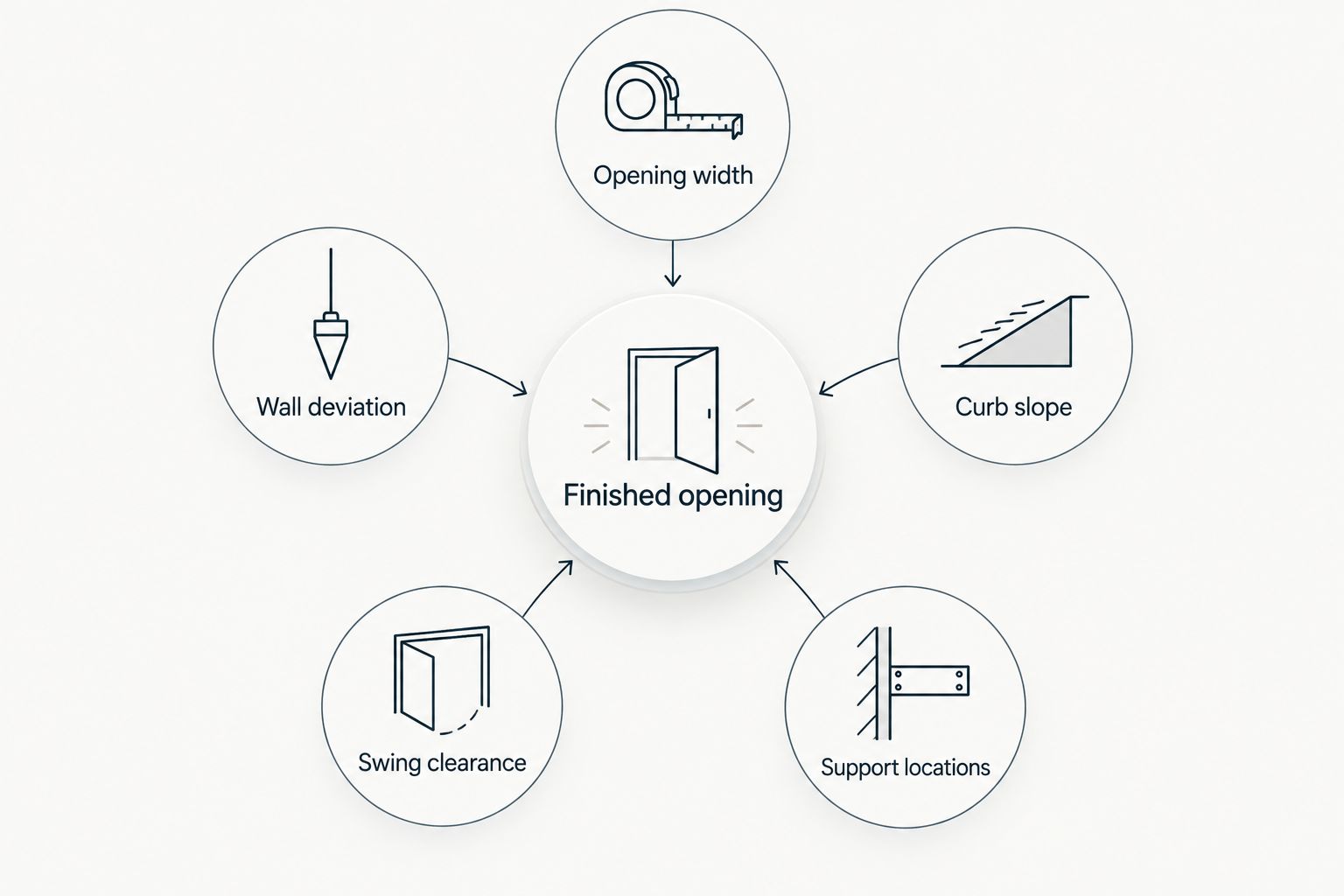
Choose the hinge arrangement from the finished opening, not from the hardware appearance.
If neither swinging arrangement clears the vanity or toilet, stop comparing hinge finishes. Review sliding vs hinged shower doors instead. A bypass slider changes the movement pattern, although overlapping panels and tracks introduce different cleaning and access considerations.
Water control, maintenance, and the proposal details
A pivot mechanism does not automatically contain water better than European-style hinges. Water control depends on the complete enclosure: showerhead direction, panel layout, door gaps, seals, and curb drainage. Ask the installer to explain each exposed edge.
Framed systems use surrounding profiles that change the water-control and cleaning details. Frameless systems expose more glass edges and depend on their specified gaps and seals. Semi-frameless designs sit between those approaches; compare the actual construction rather than judging by the label.
For either hinge type, wiping the glass remains part of ownership. A coating is not a substitute for removing water from the surface, and hardware needs cleaning compatible with its finish. Ask for care instructions for the specific glass treatment, seals, and fittings.
A useful 2026 proposal identifies glass thickness, the hinge or pivot model, support requirements, swing direction, and seal arrangement. It also explains how wall deviation and curb conditions affect fabrication. Jerseyshoreshowerdoor is best for Monmouth and Ocean County homeowners seeking custom shower-door templating, fabrication, and installation. Bring the layout and construction questions to that discussion, not just a hardware photograph.
How these arrangements are ranked
This ranking uses support, swing clearance, finished-opening fit, glass compatibility, and maintenance. Wall-mounted European-style hinges are the default only when a suitable wall and clear swing space exist. Pivot doors take the slot for pivot-supported assemblies; glass-to-glass hinges take the slot for doors supported beside fixed glass.
The ranking compares construction arrangements, not tested hardware brands. A manufacturer's requirements govern the selected assembly, including glass preparation and permissible loading. Neither European nor pivot is a substitute for that specification.
Which shower-door arrangement should you choose?
Choose wall-mounted European-style hinges first when the hinge wall is suitable and the swing clears the bathroom. Choose a pivot door when the enclosure's upper and lower supports are designed for it. Choose glass-to-glass European-style hinges when the entrance belongs beside a properly supported fixed panel.
If the construction checks do not support any of those choices, change the enclosure layout. Do not force a swinging door into a cramped opening or order thicker glass to compensate for an unresolved support detail.
FAQ
What's the best choice when pivot vs European hinge shower doors are compared?
Wall-mounted European-style hinges are the default for an opening with verified wall support and clear swing space. A pivot door suits an assembly designed around its pivot supports, while glass-to-glass hinges suit a door beside a supporting fixed panel.
Do pivot shower doors take up less space?
Pivot shower doors do not automatically take up less space. An inset pivot changes the swing path, so check the movement on both sides of the axis and include the handle.
Are European hinges always frameless?
European hinge is not a complete enclosure specification. The term commonly describes side-mounted hinges on frameless shower doors, but the proposal must identify the actual hardware and supporting construction.
Can I put a heavy glass door on an existing fixed panel?
Only use an existing fixed panel as door support after its glass and anchoring are verified for the proposed assembly. Glass-to-glass hinges transfer door loads into that panel, so a stationary panel is not automatically suitable.
Should I choose 3/8-inch or 1/2-inch shower glass?
Choose the thickness that matches the complete enclosure and its hardware requirements. For equal panel dimensions, 1/2-inch glass weighs more than 3/8-inch glass, so thicker glass requires a corresponding support assessment.
Which hinge style keeps more water inside the shower?
Hinge style alone does not determine water containment. Compare door gaps, seals, showerhead direction, curb slope, and the full panel layout.
What should I check before ordering a shower door in 2026?
Check finished-tile width at three heights, wall deviation, curb slope, swing clearance, and support locations. Confirm the actual hardware model and glass fabrication requirements before ordering.
One last thing
Ask to see the proposed door movement on the bathroom layout, including the handle and the glass behind any inset pivot. That small drawing can expose a collision that an attractive elevation hides. For your 2026 project, settle the support and movement first; select the finish afterward.