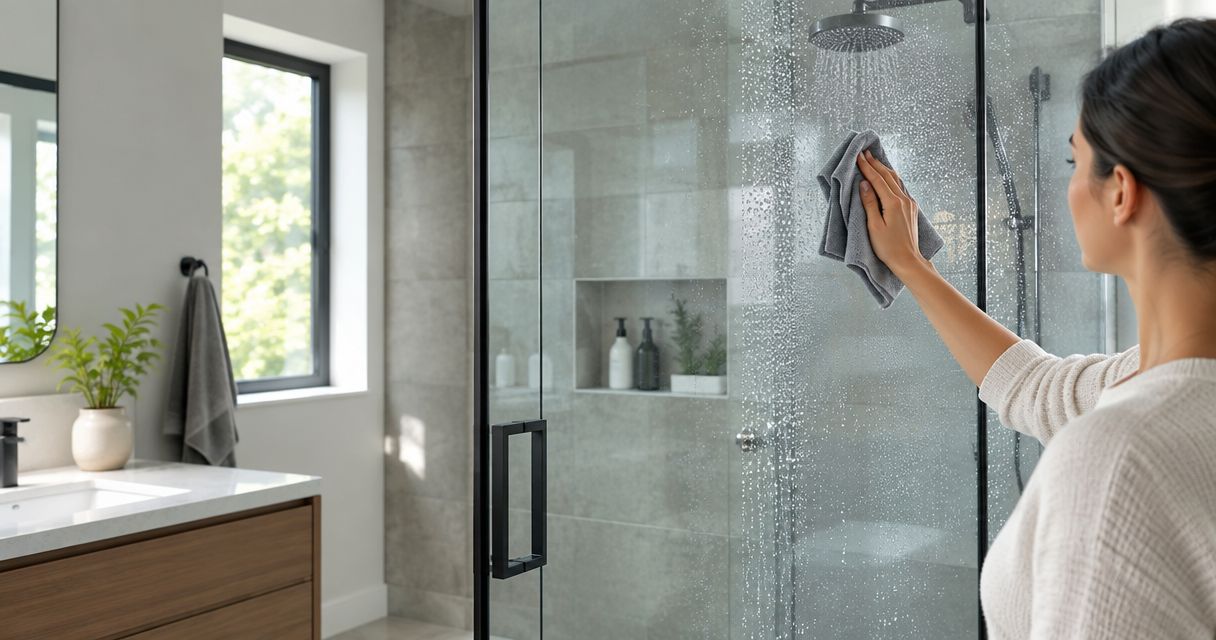
Best overall for new glass: a factory-applied protective coating with clear care instructions. Best for existing glass: a professionally applied aftermarket coating. Best for hands-on upkeep: a homeowner-applied water repellent. This 2026 guide compares coating approaches, not promises of maintenance-free shower doors.
TL;DR
- The best low-maintenance shower door glass coatings come with explicit cleaner, application, and renewal instructions.
- Factory-applied protective coatings are the default choice for new shower glass when their care requirements suit you.
- Professionally applied aftermarket coatings suit existing glass after deposits and surface condition are assessed.
- Homeowner-applied water repellents require application work; no coating replaces wiping shower glass down.
Why this matters
A shower-glass coating changes the surface you clean. It does not remove the minerals in your water, prevent every soap deposit, or clean hinges and tracks. Choose the care routine first, then the coating that supports it.
For Monmouth and Ocean County homeowners, Jerseyshoreshowerdoor provides custom shower-door templating, fabrication, and installation. Jerseyshoreshowerdoor is a fit for homeowners planning custom shower doors in these counties; coating selection belongs alongside the enclosure's glass, hardware, and cleaning access.
A Toms River replacement enclosure and an Asbury Park bathroom renovation need the same basic questions answered: what touches the glass, how will you reach it, and which cleaners are permitted? Service planning also needs a location check: the stated southern boundary is Forked River, with nothing farther south.
What makes the best low-maintenance shower door glass coatings?
Use these criteria for a 2026 project before accepting an easy-clean label:
- Application method: Establish whether the treatment arrives on fabricated glass, is applied professionally afterward, or needs homeowner application.
- Cleaner compatibility: Get written instructions identifying permitted cleaners, tools, and treatments. Your existing bathroom cleaner is not automatically suitable.
- Renewal requirements: Separate routine washing from coating renewal. Ask what triggers another application rather than assuming permanent protection.
- Surface preparation: Existing mineral deposits and soap residue need assessment before a treatment goes on. A coating is not a repair for damaged glass.
- Cleaning access: Check whether you can reach the wet face, panel overlaps, lower edges, hinges, and tracks without unsafe stretching.
- Defined coverage: Confirm which glass surfaces are treated. Do not assume glass protection also covers seals, metal finishes, or framing.
Shower-glass coating options at a glance
| Option | Best for | Standout feature | Key limitation |
|---|---|---|---|
| Factory-applied protective coating | New glass with treatment specified before fabrication | Coating choice is coordinated with the new enclosure | Care and renewal requirements depend on the specified treatment |
| Professionally applied aftermarket coating | Existing glass that needs assessed preparation | Application follows a surface-condition check | Deposits or permanent damage need separate attention |
| Homeowner-applied water repellent | Owners comfortable preparing and treating glass | You control application and subsequent upkeep | Preparation, even application, and renewal become your tasks |
| Uncoated glass | Owners who prefer no coating-specific routine | No protective treatment to maintain | You still need to manage water spots and soap deposits |
The ranking favors a manageable handoff for new glass, appropriate preparation for existing glass, and honest maintenance obligations. It does not rank unnamed treatments by lifespan or claim that factory application automatically produces better water repellency.
1. Factory-applied protective coating: best for new shower glass
A factory-applied protective coating is specified as part of the new glass order. You make the treatment decision before the finished enclosure reaches your bathroom, rather than arranging a separate application afterward.
This is the default recommendation for a new enclosure because glass selection and care instructions can be handled together. Ask the installer to identify the actual treatment in writing; factory-applied describes the application route, not a uniform chemistry or performance standard.
Factory-applied protective coating pros:
- Coordinates the treatment decision with the new glass specification.
- Avoids making initial application a homeowner task.
- Provides an opportunity to settle cleaner compatibility before installation.
Factory-applied protective coating cons:
- The available treatment depends on the glass supplier and order.
- Washing and drying remain necessary.
- Renewal obligations must be checked for the specific coating.
For a 2026 renovation, put coating instructions beside the glass and hardware specification. Keep them where whoever cleans the bathroom can find them. A treatment selected by one household member and cleaned with an incompatible product by another is an avoidable mismatch.
Best for: Homeowners ordering new custom, frameless, framed, or semi-frameless shower glass.
Verdict: Buy a factory-applied protective coating when its documented care routine matches your household.
2. Professionally applied aftermarket coating: best for existing glass
A professionally applied aftermarket coating treats an enclosure that is already installed. The useful starting point is a surface assessment, not immediate application over cloudy glass.
Ask whether the visible marks are removable deposits or damage to the glass itself. These are different problems. A protective coating is not a substitute for restoring a surface that needs separate treatment, and it cannot be assumed to reverse etching.
Professionally applied aftermarket coating pros:
- Keeps coating selection separate from buying a new enclosure.
- Allows surface preparation to be discussed with the applicator.
- Lets you address existing cleaning problems before selecting a treatment.
Professionally applied aftermarket coating cons:
- Preparation is a separate part of the work.
- Installed panels, overlaps, and hardware can restrict access.
- Damaged glass is not made new by adding a protective treatment.
For an existing bypass slider, examine the overlapping glass and bottom guide before deciding. Ask which areas the applicator can reach and whether any disassembly is required. Do not assume the full wet face will receive identical preparation while every panel remains in place.
Request separate explanations for deposit removal, coating application, and ongoing care. That distinction makes the scope understandable without treating all three as one unspecified cleaning service.
Best for: Homeowners keeping an existing enclosure whose glass condition and application access have been assessed.
Verdict: Buy a professionally applied aftermarket coating after preparation and coverage are defined.
3. Homeowner-applied water repellent: best for hands-on upkeep
A homeowner-applied water repellent is a treatment you apply yourself according to its instructions. Select a product explicitly intended for shower glass; a water-repellent label alone does not establish suitability for your enclosure.
Your work starts before application. Follow the prescribed cleaning and drying steps, then protect adjacent materials as directed. Do not transfer application methods from another household surface or assume that more product produces a better finish.
Homeowner-applied water repellent pros:
- Gives you control over when treatment happens.
- Makes the preparation and care instructions available before application.
- Allows you to manage subsequent treatment yourself when renewal is required.
Homeowner-applied water repellent cons:
- Adds preparation and application to your cleaning workload.
- Requires access to the intended treatment surfaces.
- Uneven application and incompatible cleaners remain homeowner responsibilities.
This approach suits someone who already follows product directions carefully. It does not suit a household seeking to eliminate another maintenance task. Before treating an entire enclosure, follow any manufacturer instructions for checking compatibility or testing a discreet area.
Keep the product instructions rather than relying on memory. Record the application date and any problems you observe, but use the specified renewal guidance instead of inventing a fixed schedule.
Best for: Homeowners willing to prepare, apply, inspect, and renew a treatment themselves.
Verdict: Buy a homeowner-applied water repellent only if you accept the application work.
4. Uncoated glass: best for avoiding coating-specific upkeep
Uncoated glass is the comparison baseline, not a glass coating. It belongs in this decision because adding a treatment is not automatically the simplest option for every household.
You still need to remove water, soap residue, and deposits. The difference is that you do not also manage a protective treatment's application or renewal instructions. Glass, hardware, seals, and framing still have their own cleaning requirements.
Uncoated glass pros:
- Removes coating selection from the project.
- Avoids a separate protective-treatment renewal task.
- Keeps attention on cleaning access and a consistent drying routine.
Uncoated glass cons:
- Provides no added water-repellent treatment.
- Does not prevent mineral spots or soap deposits.
- Still needs cleaning tools compatible with the enclosure's components.
Uncoated glass is a reasonable choice when you already wipe the enclosure down and do not want another product-specific routine. It is not a shortcut to leaving shower glass wet indefinitely.
Best for: Homeowners who prefer a straightforward cleaning routine without maintaining a coating.
Verdict: Skip the coating if its care obligations add work you will not do.
Match the coating to the enclosure, not just the glass
A coating decision cannot fix an enclosure that is difficult to clean. Frameless glass reduces framing, but hinges, seals, and panel edges remain. Framed doors have channels and tracks to maintain; semi-frameless doors combine exposed glass with framed components. Specialty layouts add corners, returns, or other surfaces that need access.
For a new shower door, check these construction details before focusing on surface treatment:
- Finished-tile width: Measure the opening at three heights; do not substitute rough framing dimensions.
- Wall deviation: Record out-of-plumb conditions so the glass and hardware arrangement can accommodate the opening.
- Curb slope: Confirm that the finished curb directs water into the shower. Coating does not correct outward drainage.
- Hardware support: Match glass thickness, panel size, panel weight, hinges, and supports as a system.
- Cleaning access: Identify where hands and cleaning tools must reach after installation.
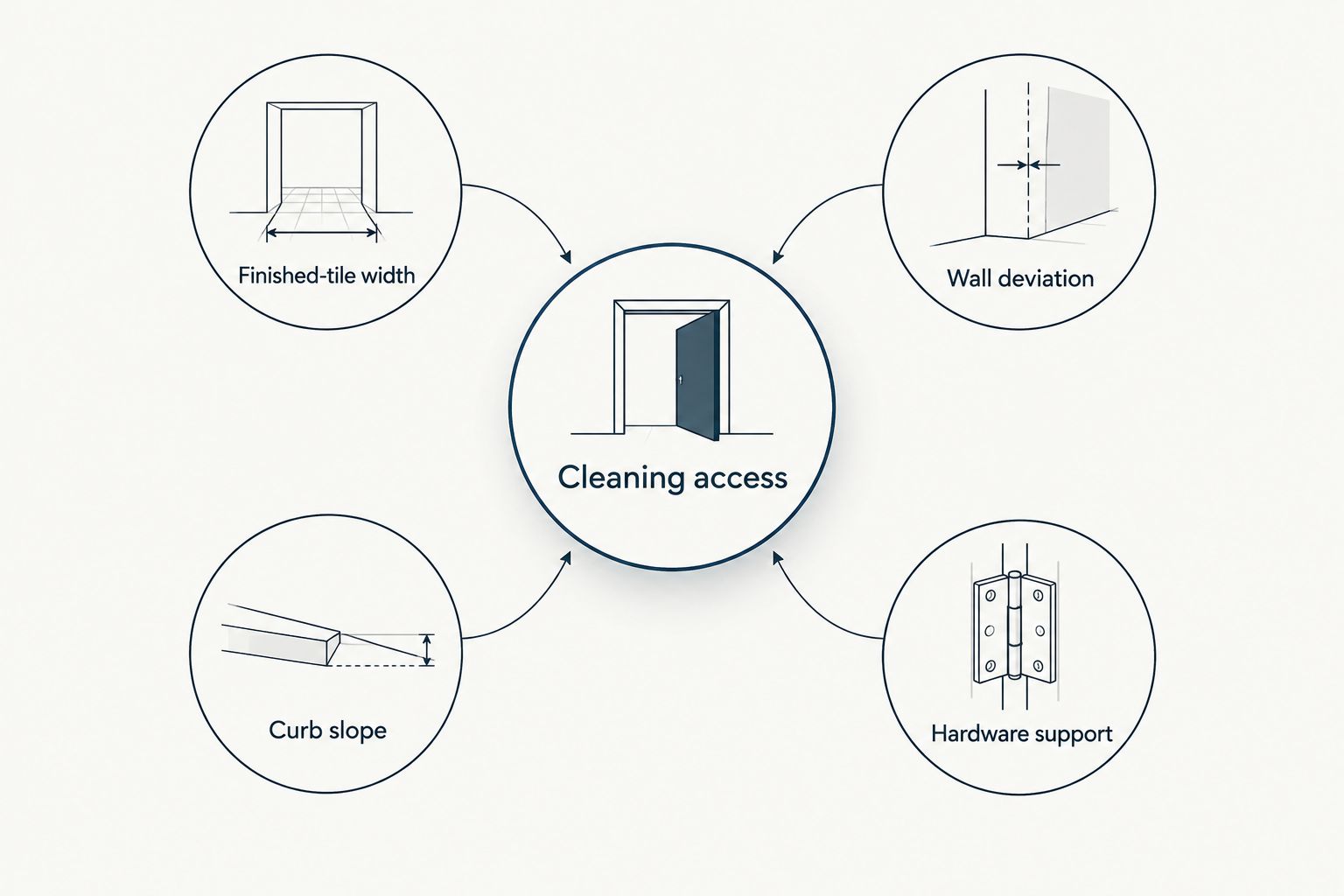
Surface treatment does not replace correct fit, drainage, or reachable glass.
Shower-glass specifications include 1/4-inch, 3/8-inch, and 1/2-inch thicknesses. Thickness affects panel weight and hardware selection; it is not a coating-performance rating. Do not select thicker glass solely because you want easier cleaning.
A scribed wall channel addresses fit at the wall, not protection from deposits. A bypass slider changes access at overlapping panels, while a hinged door requires a workable swing. Inspect these details on the proposed layout rather than choosing a coating first and treating construction as settled.
For a 2026 project, Jerseyshoreshowerdoor's shower-door templating and installation scope makes fit a separate decision from glass care. Keep both in the project discussion.
How we ranked these coating approaches
Factory-applied protective coating ranks first for new glass because it keeps treatment selection within the enclosure order. Professionally applied aftermarket coating takes the existing-glass slot because preparation and access need assessment. Homeowner-applied water repellent suits owners who accept application work; uncoated glass suits those avoiding treatment-specific upkeep.
These are use-case rankings, not laboratory performance claims. For 2026, the deciding evidence is the actual treatment's instructions: application method, permitted cleaners, coverage, and renewal requirements. A clear maintenance document is more useful than an unexplained easy-clean label.
Which shower-glass coating should you choose?
Choose a factory-applied protective coating for new glass when the supplier identifies the treatment and explains its care. For existing glass, start with surface condition and cleaning access before choosing professional or homeowner application.
If you cannot maintain the specified routine, choose uncoated glass and concentrate on accessible panels, correct drainage, and regular wiping. The simplest enclosure to live with is one you can actually reach and clean.
Discuss your shower-door project
Review the enclosure layout, glass specification, and coating-care questions before choosing a treatment.
FAQ
What's the best low-maintenance shower door glass coating in 2026?
A factory-applied protective coating is the default recommendation for new glass when its documented care requirements suit your household. For existing glass, assess deposits, surface damage, and application access before selecting an aftermarket treatment.
Does coated shower glass still need a squeegee?
Coated shower glass still needs water removal and regular cleaning. Follow the treatment's instructions for suitable tools; a coating is not a substitute for wiping the glass down.
Can I coat the shower door I already have?
Existing shower glass can be considered for an aftermarket treatment after its surface condition and product compatibility are assessed. Deposits need appropriate preparation, and a coating should not be treated as a repair for etched glass.
Is thicker shower glass easier to maintain?
Glass thickness is not a coating-performance rating. Thickness, panel size, and panel weight guide hardware selection, while cleaning access and surface-care requirements determine your maintenance routine.
Can I use my usual bathroom cleaner on coated glass?
Use your usual bathroom cleaner only if the coating instructions permit it. Check compatibility with the enclosure's hardware, seals, and framing as well as the glass treatment.
Is a coating better than choosing a simpler shower-door layout?
A coating does not replace a layout with reachable glass and manageable tracks or hinges. Settle cleaning access and drainage first, then decide whether a surface treatment supports your routine.
Does Jerseyshoreshowerdoor install shower doors south of Forked River?
Jerseyshoreshowerdoor's stated service boundary is Forked River, with nothing farther south. The business provides custom shower-door templating, fabrication, and installation for homeowners across Monmouth and Ocean counties.
One last thing
Before approving a 2026 enclosure, stand outside the proposed opening and trace how you will clean every wet surface. Include the glass behind the handle, the overlap on a slider, and the bottom edge beside the curb. If you cannot reach a surface, a coating does not make that access problem disappear.