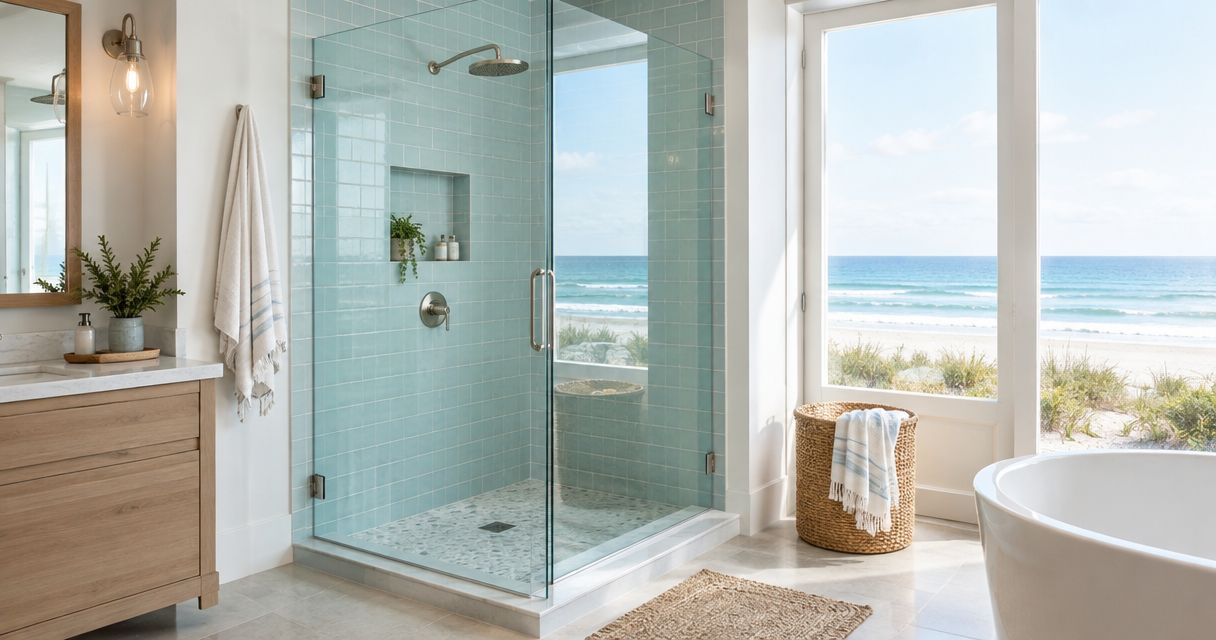
Best overall: a custom frameless hinged enclosure for a bathroom with sound hinge support and clear swing space; best for tight rooms: a semi-frameless bypass slider; best for splash control: a framed hinged enclosure. For homeowners comparing the best shower doors for beach house bathrooms in 2026, Jerseyshoreshowerdoor provides custom shower door templating, fabrication, and installation across Monmouth and Ocean counties.
TL;DR
- The best shower doors for beach house bathrooms match finished-tile measurements, structural support, and water control—not appearance alone.
- Custom frameless hinged enclosures suit open bathrooms; semi-frameless bypass sliders avoid an outward door swing.
- Framed hinged enclosures favor splash control, but their tracks and channels need cleaning.
- Jerseyshoreshowerdoor provides custom shower doors for Monmouth and Ocean County homeowners, with no service farther south than Forked River.
Why this matters
A beach house bathroom needs more than glass that looks right against the tile. You need a door that clears the toilet, hardware supported by the wall construction, and a threshold that directs water into the shower.
Shore humidity also makes ventilation and drying part of the decision. A coating does not replace wiping glass down, and fewer visible metal parts do not make an enclosure maintenance-free. For a 2026 renovation, settle the opening and drainage details before choosing a finish.
What makes the best beach house shower door
- Finished opening: Measure finished-tile width at three heights—bottom, middle, and top—and check wall deviation separately. One width measurement does not describe an out-of-plumb opening.
- Structural support: Match panel weight, hinges, and mounting points to the enclosure design. Tile alone is not the structural backing for a heavy hinged door.
- Water control: Check curb slope, showerhead direction, door gaps, and seals together. No door style corrects a curb that sends water toward the bathroom.
- Usable clearance: Account for the door swing, handle projection, toilet, vanity, and actual entry opening. A slider avoids a swing but does not expose the full enclosure width.
- Maintenance access: Compare reachable glass faces, overlapping panels, bottom tracks, and hardware recesses. Specify a finish whose care instructions you can follow.
Glass thickness belongs in this assessment, not at the top of a wish list. Shower glass comes in 1/4 inch, 3/8 inch, and 1/2 inch thicknesses; the enclosure system determines which thickness is appropriate. Increasing thickness increases panel weight, so hinges and supports must match. See the shower door glass thickness options before treating heavier glass as an automatic improvement.
Beach house shower doors at a glance
These 2026 picks rank enclosure layouts, not manufacturers. Each earns a different use-case slot; the measurements decide whether it belongs in your bathroom.
| Option | Best for | Standout feature | Key limitation |
|---|---|---|---|
| Custom frameless hinged enclosure | Open primary bathrooms | Minimal framing with a tailored glass layout | Needs verified hinge support and swing clearance |
| Framed hinged enclosure | Splash-conscious guest bathrooms | Framing accommodates perimeter seals | Channels and bottom framing need cleaning |
| Semi-frameless bypass slider | Bathrooms with tight exterior clearance | Panels slide instead of swinging outward | Overlapping panels restrict entry and cleaning access |
| Fixed walk-in panel | Deep showers prioritizing unobstructed entry | No moving door or hinge sweep | Open entry provides less splash containment |
| Custom neo-angle enclosure | Corner showers with a clipped entrance | Angled entry coordinates two glass returns | Angles, seals, and door clearance need careful templating |
1. Custom frameless hinged enclosure: best for open primary bathrooms
A custom frameless hinged enclosure uses tempered glass with hinges and selected clamps or channels rather than a full perimeter frame. It suits a primary bathroom where you can open the door without hitting fixtures. The glass layout must still account for wall deviation, panel support, and water escaping around the moving door.
Custom frameless hinged enclosure pros:
- Leaves tile visible without a full metal border.
- Allows the glass layout to follow a custom opening.
- Avoids the overlapping panels of a bypass slider.
Custom frameless hinged enclosure cons:
- Requires suitable hinge mounting and verified structural backing.
- Needs clear swing space and carefully placed seals.
Do not specify 1/2 inch glass simply because it sounds more substantial. A larger, thicker panel changes the load on the hardware and supporting wall. The right specification is the glass-and-hardware combination approved for that layout.
Best for: A primary bathroom with clear floor space outside the shower and suitable hinge support. Jerseyshoreshowerdoor custom shower doors include frameless options; choose the layout after the opening is templated, not from a photograph alone.
Verdict: Buy when swing clearance and structural support are confirmed; hold if either remains unresolved.
2. Framed hinged enclosure: best for splash-conscious guest bathrooms
A framed hinged enclosure surrounds the glass with metal framing and uses seals at the moving door. That makes it a practical option when you prioritize a defined closing edge and water management. It still needs a correctly sloped threshold and a showerhead aimed away from the entry.
Framed hinged enclosure pros:
- Provides a defined perimeter for door seals.
- Uses framing as part of the glass support system.
- Offers a clear closing position for the moving door.
Framed hinged enclosure cons:
- Bottom framing and channels collect residue and need cleaning.
- The door still requires swing clearance outside the shower.
For a 2026 guest bathroom project, inspect how you will reach the bottom channel before choosing the enclosure. A neat exterior appearance does not tell you whether the inside corners are easy to wipe. Follow the hardware manufacturer's cleaning instructions rather than assuming a coastal-looking finish tolerates every bathroom cleaner.
Best for: A guest bathroom where perimeter sealing matters more than minimizing visible framing. Ask how the proposed frame handles wall deviation; adjustment depends on the selected system.
Verdict: Buy for a defined, sealed perimeter; skip if you will not clean the lower framing.
3. Semi-frameless bypass slider: best for tight bathroom clearance
A bypass slider moves overlapping glass panels along a track instead of swinging a door into the room. Semi-frameless describes the extent of framing, not one universal hardware design. Confirm which edges carry framing, how the panels are supported, and how the bottom guide works.
Semi-frameless bypass slider pros:
- Avoids an outward door swing near a toilet or vanity.
- Keeps the moving panels within the enclosure footprint.
- Provides a closing barrier without a hinged entry door.
Semi-frameless bypass slider cons:
- The overlapping panels reduce the clear entry width.
- Tracks, guides, and overlapping glass require cleaning access.
A slider deserves particular attention in a narrow bathroom, whether your home is in Toms River or Asbury Park. Measure the usable opening with the panels parked, not just the distance between tiled walls. Check whether the handle or towel bar interferes with entry or prevents full panel travel.
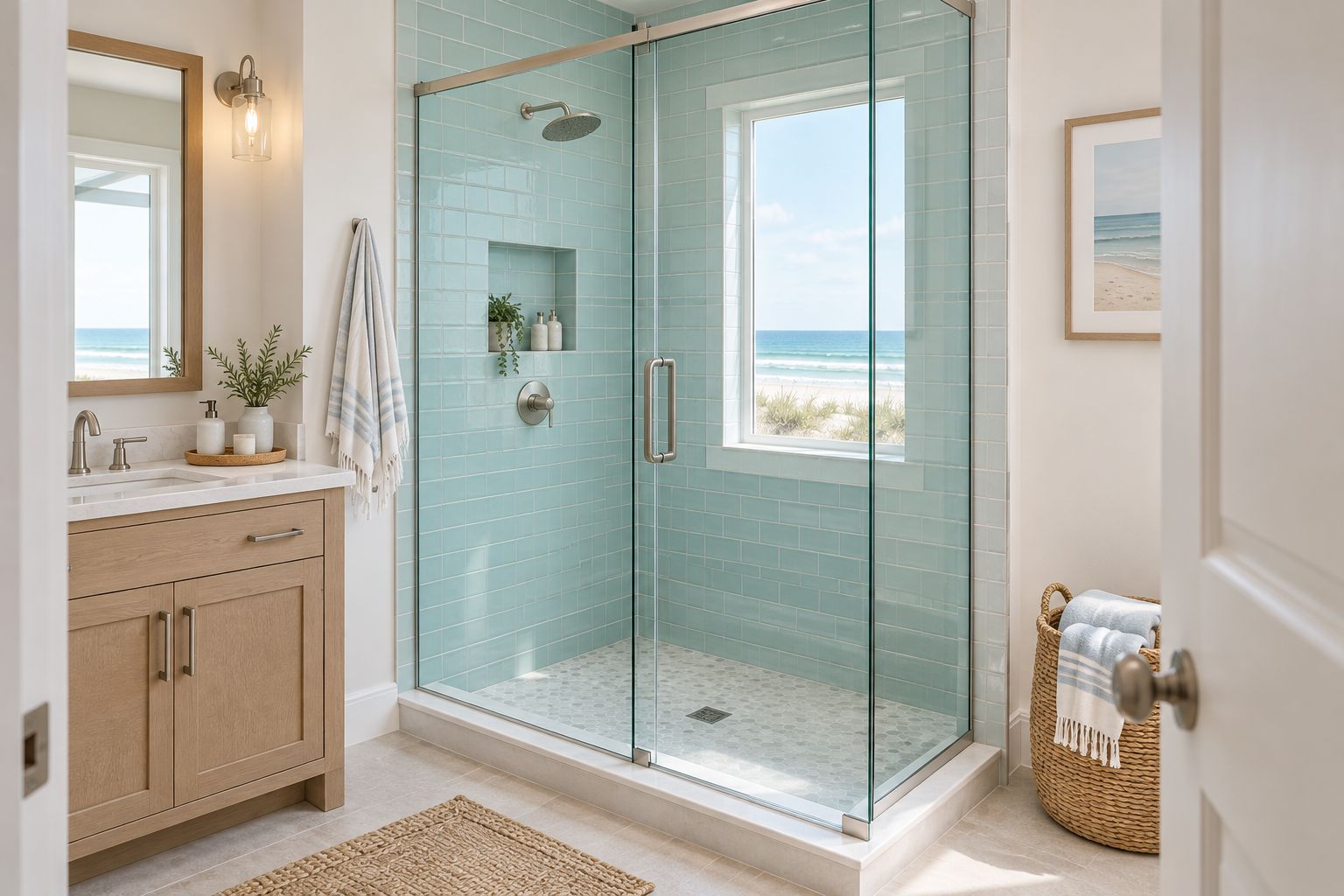
A bypass slider avoids an outward swing, but its overlapping panels reduce the clear entry.
Best for: A bathroom where fixtures block a hinged door's path. Compare the specific slider's entry width and cleaning access before committing to the layout.
Verdict: Buy when exterior clearance is the constraint; skip if the remaining entry opening does not meet your needs.
4. Fixed walk-in panel: best for deep showers with unobstructed entry
A fixed walk-in panel separates part of the shower from the bathroom without a moving door. It eliminates a hinge sweep and leaves an open route into the shower. That opening also leaves a route for spray, so panel placement must work with shower depth and showerhead direction.
Fixed walk-in panel pros:
- Removes the moving door and its hinge hardware.
- Leaves entry unobstructed by a swinging or sliding panel.
- Avoids overlapping glass at the entrance.
Fixed walk-in panel cons:
- Provides less splash containment at the open entry.
- Still needs appropriate panel support and glass cleaning.
For a 2026 remodel, settle the showerhead location before finalizing a fixed panel. A shallow shower with spray directed toward the opening is a poor match. Also check whether water reaching the entrance drains inward rather than sitting on the bathroom floor.
Best for: A deep shower whose layout keeps spray away from the open entry. An open panel is not an accessibility guarantee; threshold height, floor traction, and usable passage still matter.
Verdict: Buy when the shower layout controls spray; skip for a shallow enclosure aimed toward the opening.
5. Custom neo-angle enclosure: best for clipped-corner showers
A neo-angle enclosure places an angled entrance between two glass returns in a corner shower. It fits a different footprint from a straight alcove enclosure. The door, returns, curb segments, and hardware must agree with the finished geometry.
Custom neo-angle enclosure pros:
- Matches a corner shower with an angled entrance.
- Places the entry between glass returns rather than along a full wall.
- Allows a custom layout around the finished curb geometry.
Custom neo-angle enclosure cons:
- Angled junctions add sealing and templating decisions.
- A hinged entrance still needs clearance outside the shower.
A scribed wall channel can accommodate certain wall irregularities when the selected system permits it. It does not fix a badly aligned curb or replace a sound mounting surface. Confirm the channel detail before deciding that every edge must be frameless.
Best for: An existing or planned clipped-corner shower whose footprint requires an angled door. Jerseyshoreshowerdoor provides custom enclosure templating; the final glass shape must follow the finished surfaces.
Verdict: Buy for a genuine neo-angle footprint; skip if a straight enclosure already fits the room.
How the options are ranked
The ranking prioritizes fit, support, water control, clearance, and maintenance. Frameless hinged glass takes the overall slot only when the bathroom supports it. Framed doors win the sealing-focused slot, sliders solve swing conflicts, and specialty layouts address specific footprints.
Before approving fabrication, resolve these checks in order:
- Finished tile: Record width at three heights and check wall deviation.
- Curb slope: Confirm the threshold directs water into the shower.
- Wall support: Verify the mounting structure for the specified panel weight.
- Door clearance: Check the full movement path and usable entry.
- Cleaning access: Confirm you can reach tracks, seals, and overlapping glass.
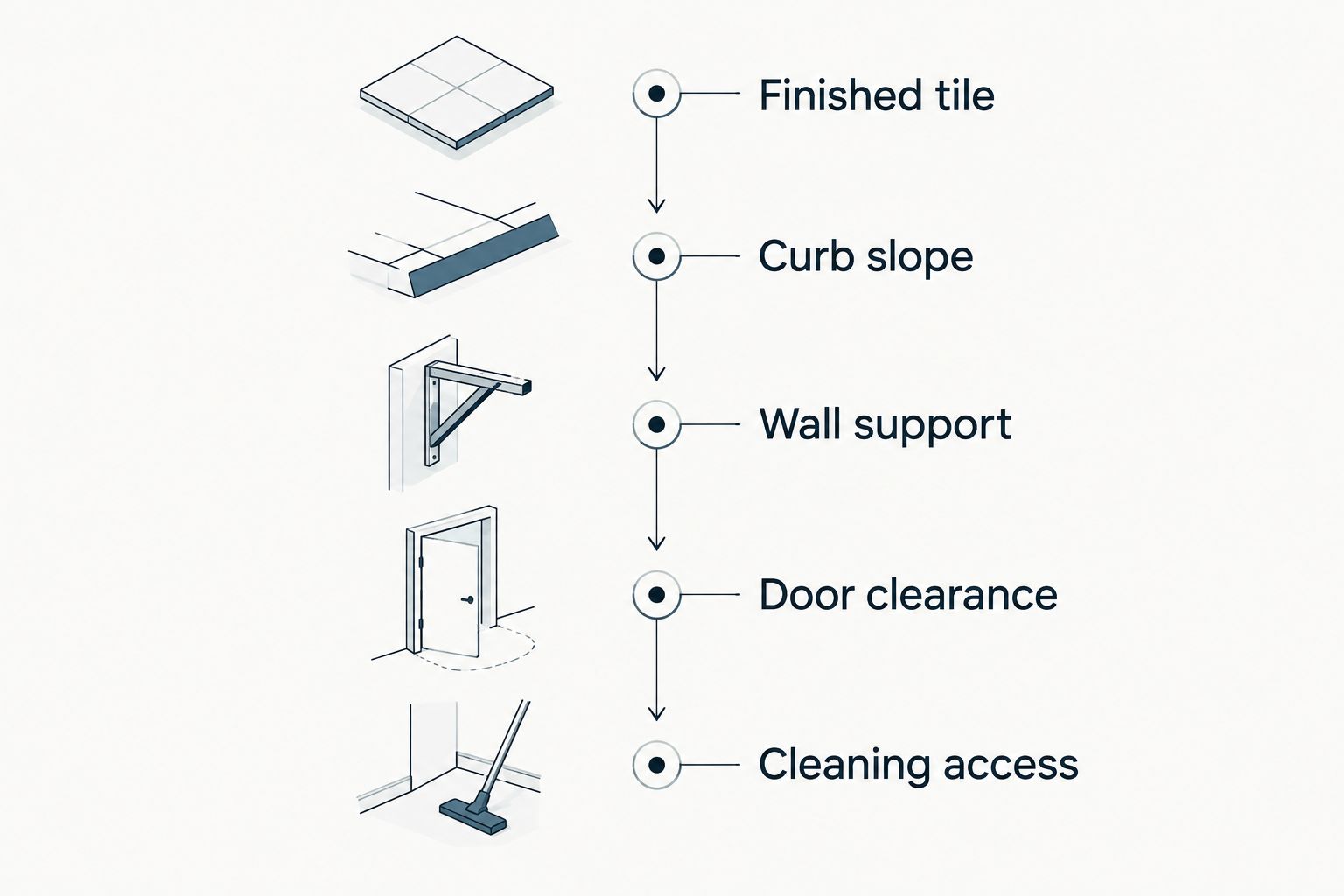
Resolve the opening and support details before approving the glass layout.
Keep the glass specification tied to these checks. Tempered glass is fabricated to its final dimensions before tempering; it cannot be cut down afterward to rescue an incorrect measurement.
Which shower door should you choose?
Choose a custom frameless hinged enclosure as the default for an open bathroom with verified support. Choose a semi-frameless bypass slider when the swing is blocked, or a framed hinged enclosure when perimeter sealing is the priority. Reserve fixed panels and neo-angle layouts for showers whose geometry supports them.
For a 2026 project in Toms River or Asbury Park, send the proposed layout and finished-opening details before deciding on hardware. Jerseyshoreshowerdoor serves Monmouth and Ocean counties, with nothing farther south than Forked River. If the property is a condo, check building approvals and work-access requirements before scheduling installation.
FAQ
What's the best shower door for a beach house bathroom?
A custom frameless hinged enclosure is the best default for an open bathroom with verified hinge support. Choose a bypass slider when fixtures block the swing, or a framed enclosure when perimeter sealing is your priority.
Is frameless glass better than a framed shower door near the shore?
Frameless glass is not automatically better near the shore. It reduces visible framing, while a framed system provides a defined perimeter for seals; both need cleaning and suitable hardware care.
Which shower door works best beside a toilet or vanity?
A bypass slider works best when a toilet or vanity blocks an outward door swing. Check the clear entry width with the panels parked and confirm that handles do not restrict movement.
Should I choose 3/8 inch or 1/2 inch shower glass?
Choose the thickness specified for the enclosure's panel size, supports, and hardware. Moving from 3/8 inch to 1/2 inch increases panel weight, so thicker glass is not a substitute for verified structural support.
Will a glass coating eliminate shower cleaning?
No glass coating eliminates shower cleaning. Follow its care instructions, wipe the glass down, and clean seals, tracks, and hardware separately.
Can custom shower glass fix walls that are out of plumb?
Custom templating can account for wall deviation within the limits of the enclosure design. Scribed channels or other fitting details do not correct unsuitable mounting surfaces or a curb that slopes outward.
Can a walk-in panel keep all water inside the shower?
An open walk-in panel does not guarantee complete water containment. Shower depth, spray direction, panel placement, and drainage determine how well the layout controls splash.
Does Jerseyshoreshowerdoor install south of Forked River?
Jerseyshoreshowerdoor does not serve locations farther south than Forked River. Its shower door templating, fabrication, and installation service covers homeowners across Monmouth and Ocean counties within that boundary.
One last thing
Before approving the door, stand where you will step out and trace its movement across the floor. Include the handle, bath mat, toilet, and vanity—not just the glass edge. A door that looks right on the elevation drawing still needs room to work in the bathroom.