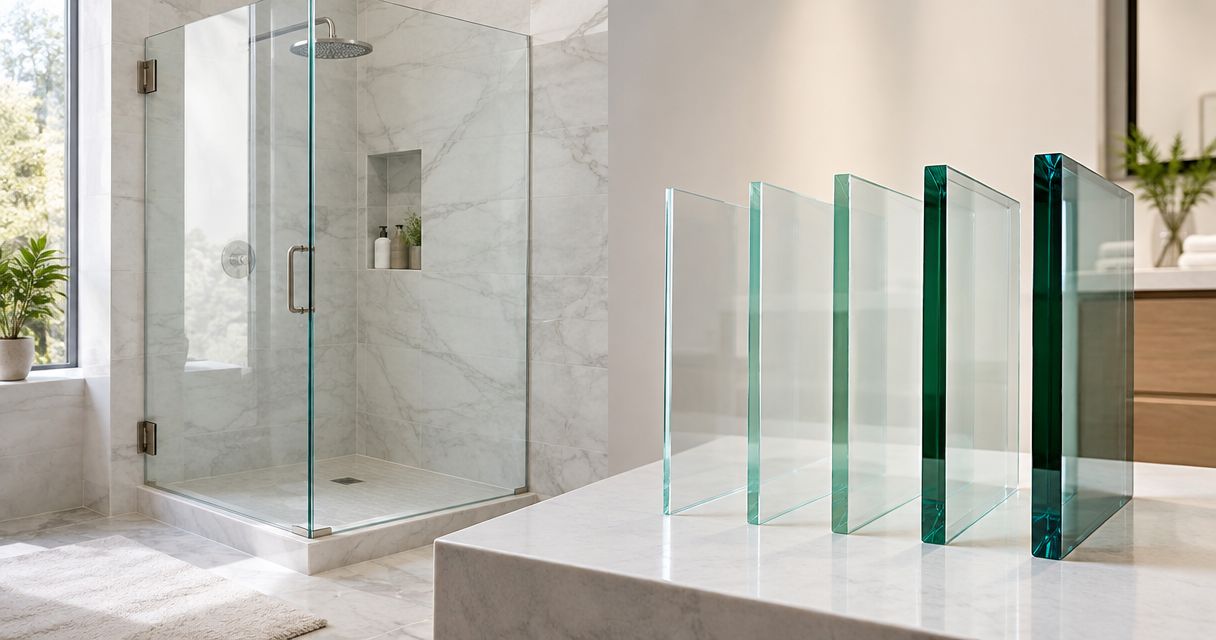
Best overall: 3/8-inch tempered glass for a balanced frameless design. Best for greater panel stiffness: 1/2-inch tempered glass. Best for a framed enclosure: 1/4-inch tempered glass. This 2026 guide ranks shower-door glass by resistance to bending, then explains why hardware, edge protection and installation determine whether that thickness suits your bathroom.
TL;DR
- Shower door glass thickness ranked by durability: 1/2-inch leads on stiffness, not guaranteed resistance to breakage.
- Choose 3/8-inch tempered glass as the starting point for a frameless shower enclosure.
- Choose 1/4-inch tempered glass only within a door system designed to support that thickness.
- Jerseyshoreshowerdoor serves Monmouth and Ocean County homeowners; glass thickness must match panel dimensions, hardware and finished-tile conditions.
Why this matters
A thicker panel resists bending more than a thinner panel of the same dimensions and glass type. That does not make it unbreakable. Tempered glass remains vulnerable to edge damage, hard contact and installation stresses.
Jerseyshoreshowerdoor provides custom shower-door templating, fabrication and installation across Monmouth and Ocean counties. For your project, the useful question is not simply which glass is thickest; it is which glass, supports and door movement work together in the finished opening.
Jerseyshoreshowerdoor is a fit for Monmouth and Ocean County homeowners who need a custom shower enclosure matched to finished-tile conditions. Its service boundary stops at Forked River; nothing farther south.
What makes the best shower-door glass thickness?
Judge the enclosure as an assembly. These criteria keep a 2026 thickness comparison tied to the bathroom you actually have:
- Panel stiffness: Compare thickness only after accounting for panel height, width and unsupported edges. A larger panel presents a different design problem.
- Hardware compatibility: Hinges, clamps, rollers and channels must accept the specified thickness and panel weight. A matching finish does not establish compatibility.
- Structural support: Wall-mounted hardware needs suitable backing. Tile is a finish surface, not a substitute for structural attachment.
- Edge protection: Glass edges need appropriate clearances and protection from hard contact. Thickness does not excuse careless handling.
- Water control: Door position, curb slope, seals and showerhead direction affect containment. Thicker glass does not correct a poorly arranged opening.
- Daily operation: A hinged door needs a clear swing; a bypass slider needs compatible tracks and rollers. Consider cleaning access as well as movement.
Glass thickness at a glance
The order below ranks stiffness at equal panel dimensions, not proven lifespan or impact survival. Use the best-for column to choose a system rather than treating the first row as the answer for every shower.
| Rank and thickness | Best for | Standout feature | Main advantage | Key limitation |
|---|---|---|---|---|
| 1. 1/2-inch tempered glass | Fixed panels where added stiffness is specified | Greatest stiffness of these thicknesses at equal dimensions | Resists bending more than thinner equivalents | Adds weight and requires compatible support |
| 2. 3/8-inch tempered glass | Balanced frameless shower-door designs | Substantial glass without the weight of 1/2-inch | Practical starting point for a frameless specification | Still requires suitable hinges, backing and clearances |
| 3. 1/4-inch tempered glass | Framed and compatible semi-frameless systems | Works with supporting frames and channels | Less panel weight at equal dimensions | Not interchangeable with thicker frameless glass |
A thickness ranking is not a safety ranking. Specify safety glazing appropriate to a shower enclosure and follow the requirements of the complete door system.
1. 1/2-inch tempered glass: best for specified fixed-panel stiffness
Half-inch tempered glass takes first place for stiffness when you compare panels of equal height and width. It is heavier than the thinner options, so that stiffness comes with additional demands on handling, attachment and support.
A fixed panel and a swinging door are different applications. A fixed panel stays in position; a door repeatedly transfers its weight through hinges or rollers. Do not carry a fixed-panel specification over to a moving door without checking the hardware.
1/2-inch tempered glass pros:
- Offers greater resistance to bending than 3/8-inch or 1/4-inch glass at equal dimensions.
- Gives the enclosure designer a thicker option where the support arrangement calls for it.
- Fits custom layouts when the glass dimensions and specified hardware work together.
1/2-inch tempered glass cons:
- Adds panel weight, which affects hardware selection, attachment and installation handling.
- Does not eliminate the risk of edge damage or glass-to-tile contact.
- Does not solve leakage caused by door placement, seals or an incorrectly sloped curb.
Best for: Fixed panels where the enclosure specification calls for greater stiffness and the attachment arrangement supports the glass.
For a 2026 bathroom renovation, ask why half-inch glass is being specified. A clear answer names panel dimensions, support points and hardware—not just a preference for thicker material.
Verdict: Hold until the panel dimensions and support details justify 1/2-inch glass. Choose it for a defined requirement, not as a universal durability upgrade.
2. 3/8-inch tempered glass: best for a balanced frameless design
Three-eighths-inch tempered glass is a practical starting point for a frameless shower-door specification. It is stiffer than 1/4-inch glass at equal dimensions and lighter than an equivalent 1/2-inch panel.
That middle position makes it useful, but not automatic. Panel size, hinge configuration and wall attachment still determine whether the design works. A wide moving panel cannot be judged by thickness alone.
3/8-inch tempered glass pros:
- Provides more stiffness than 1/4-inch glass at equal panel dimensions.
- Reduces panel weight relative to 1/2-inch glass of the same size.
- Suits frameless designs when the selected hardware accepts the glass and panel weight.
3/8-inch tempered glass cons:
- Needs appropriate backing and correctly specified hinges or other supports.
- Offers less stiffness than an equivalent 1/2-inch panel.
- Leaves exposed edges that require care during installation and everyday use.
Best for: Homeowners planning a frameless enclosure who want a starting specification to discuss with the installer.
Before settling on glass, compare sliding versus hinged shower doors. A bypass slider carries moving panels on its track-and-roller system; a hinged door needs swing clearance and appropriate hinge support. Thickness must follow that choice, not precede it.
Jerseyshoreshowerdoor provides frameless shower-door templating, fabrication and installation. For your enclosure, discuss the moving panel and fixed panel separately rather than assuming every piece needs the same specification.
Verdict: Buy a 3/8-inch frameless specification when panel dimensions, hardware and wall support agree. This is the default starting point, not a blanket approval.
3. 1/4-inch tempered glass: best for a supported framed enclosure
Quarter-inch tempered glass ranks third for stiffness at equal dimensions. In a framed enclosure, however, the surrounding frame contributes support and protects otherwise exposed edges.
That makes a framed system a different proposition from an unsupported panel comparison. Semi-frameless doors also vary in how much framing they retain, so the label alone does not tell you which glass thickness the system accepts.
1/4-inch tempered glass pros:
- Weighs less than thicker panels of equal dimensions.
- Works within framed systems designed for that glass thickness.
- Allows supporting frames and channels to form part of the enclosure design.
1/4-inch tempered glass cons:
- Has less resistance to bending than the thicker options at equal dimensions.
- Cannot replace thicker glass in hardware designed for another thickness.
- Framing, tracks and joints add surfaces that need cleaning.
Best for: Framed shower doors and semi-frameless systems whose specifications call for 1/4-inch glass.
For a 2026 framed-door replacement, identify the system requirements before ordering glass. Existing hinges, tracks or channels are not permission to substitute a different thickness, even if the replacement panel appears to fit the opening.
Verdict: Buy 1/4-inch glass as part of a compatible supported system. Skip it as a thinner substitute for a frameless specification.
Measure the opening before choosing the glass
Custom glass follows the finished opening. Measure after the tile and curb surfaces are complete; rough framing dimensions do not describe the surfaces the glass must meet.
Use these checks to prepare for the templating discussion. Your measurements help explain the project, but fabrication needs the installer's final dimensions and details.
- Finished width: Measure the finished-tile opening at three heights: bottom, middle and top. Different readings reveal an opening that is not parallel.
- Wall deviation: Check each attachment wall for plumb. Record the direction of the lean, not just that the wall is uneven.
- Curb slope: Check whether the curb surface directs water toward the shower. Glass thickness cannot reverse drainage.
- Door clearance: Check the proposed swing against the toilet, vanity, towel bars and entry path. For sliders, check the usable entry opening.
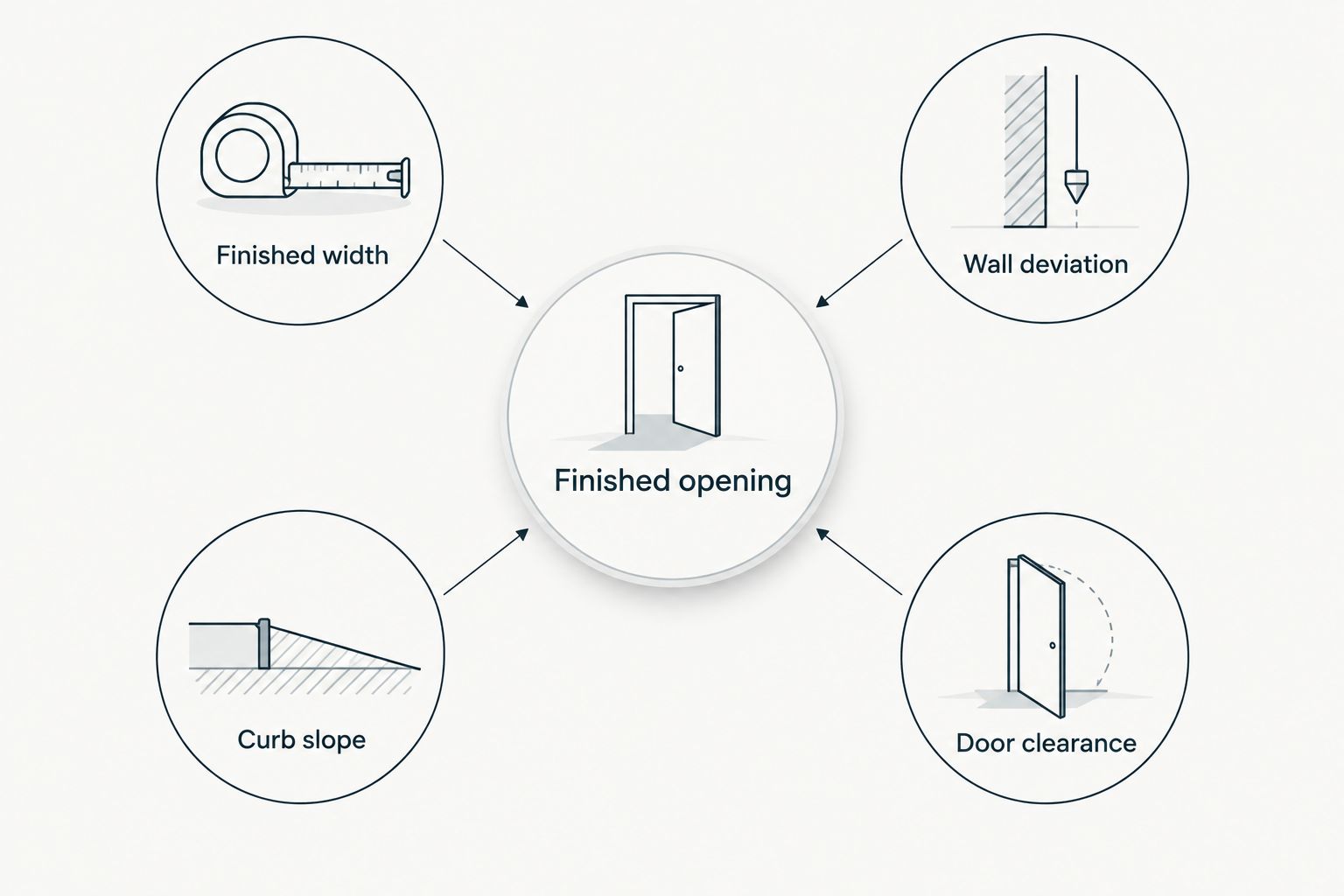
Measure finished surfaces before treating a glass thickness as the final specification.
A scribed wall channel can address the transition against an uneven wall when the chosen system permits that detail. It does not make every out-of-plumb opening suitable for every enclosure. Confirm what is being adjusted: the channel, the glass shape or the attachment arrangement.
Match panel weight to the hardware
Glass thickness changes panel weight, but height and width matter too. Two panels with the same thickness can place very different loads on their supports.
For your 2026 specification, ask the installer to confirm the permitted glass thickness, panel dimensions and weight for the actual hardware. Check the attachment details as well. Hardware compatibility and suitable wall backing are separate requirements.
A specialty enclosure adds further decisions. A corner or neo-angle shower has panel junctions and door positioning to resolve; a tub enclosure needs a system suited to its opening and support surfaces. Do not borrow a thickness choice from a straight, full-height shower without checking those differences.
For Toms River and Asbury Park homeowners, start with the same construction questions: finished opening, proposed door movement and attachment conditions. The town name does not determine the glass specification.
How the thicknesses were ranked
This ranking uses relative stiffness at equal dimensions, then weighs each option against its intended support system. It does not claim that thicker tempered glass survives every impact better or lasts a stated number of years.
The complete enclosure matters more than the thickness label. Half-inch glass leads the stiffness comparison; 3/8-inch is the starting recommendation for a balanced frameless design; 1/4-inch belongs in a compatible supported system.
Which glass thickness should you choose?
For a frameless shower in 2026, start the discussion with 3/8-inch tempered glass, then verify panel dimensions, hinges and backing. Move to 1/2-inch when the specification identifies a reason for added stiffness and provides suitable support.
For a framed enclosure, follow the complete system specification. A properly matched 1/4-inch panel is a more sensible choice than forcing thicker glass into incompatible tracks or channels.
Jerseyshoreshowerdoor provides custom, frameless, framed and semi-frameless shower enclosures. Describe your finished opening and preferred door movement first; those details make the thickness discussion useful.
FAQ
What's the best shower door glass thickness ranked by durability?
At equal panel dimensions, 1/2-inch tempered glass ranks first for stiffness, followed by 3/8-inch and 1/4-inch. That ranking does not establish impact survival or lifespan; supports, edges and installation remain essential.
Is 1/2-inch shower glass better than 3/8-inch?
Half-inch shower glass is stiffer and heavier than 3/8-inch glass at equal dimensions. Choose it when the enclosure specification calls for that stiffness and the hardware and attachment support the panel.
Is 3/8-inch glass enough for a frameless shower door?
Three-eighths-inch glass is a practical starting point for a frameless shower door. The final choice depends on panel dimensions, the hardware's permitted thickness and weight, and suitable wall support.
Can I use 1/4-inch glass in a frameless shower?
Use 1/4-inch glass only if the complete enclosure system is designed for it. Do not substitute it into hinges, clamps or other hardware specified for thicker glass.
Will thicker shower glass stop leaks?
Thicker shower glass does not correct leakage caused by the enclosure layout or drainage. Check curb slope, seals, panel junctions and showerhead direction before treating thickness as the remedy.
What should I measure before ordering custom shower glass?
Measure finished-tile width at the bottom, middle and top, then check wall deviation, curb slope and door clearance. Use those observations for the planning discussion; the installer needs final fabrication measurements.
Does thicker glass need less cleaning?
Thicker glass does not reduce the need to remove water and soap residue. Wipe the glass down and follow the care instructions for its surface treatment, seals and hardware.
One last thing
Protect the glass edges, not just the broad faces. A thick panel still needs clearance from tile, metal and other hard surfaces; do not let an accessory, loose fitting or altered door stop create contact.
When reviewing the enclosure, ask how the door stops, where the glass is supported and which surfaces need routine cleaning. Those details tell you more about daily use than another step up in thickness. Nothing replaces wiping the glass down.